Reishi Mushroom Extract Powder: Key Factors for Solubility and Batch Consistency
A lot of people think that Reishi Mushroom Extract Powder can be used in foods, beauty products, and medicines. For these to work, the powder must always be good and mixed with the right amount of water. A few things need to be checked about Reishi Mushroom Extract Powder. One question is whether it can be mixed evenly across the needed pH range. What kinds of things are in it that make it work? How stable is it from one batch to the next? This will help you finish your work faster. These things can change how well the mixture works, how stable it is, and how even it is in the end. Business-to-business teams can't just pick any Reishi Mushroom Extract Powder. They should do more than just look at price lists and artist books. People who want to buy an ingredient should also look at any other papers that back up what the ingredient says. This includes records of tracking, results of tests for contaminants, and other things. Companies that make Reishi Mushroom Extract Powder can keep exact lists of what's in it, file the right paperwork with the government, and meet their own quality standards as long as the powder stays the same quality. People who supply, make, and own brands can talk to each other more easily when the specs are clear. Setting clear quality standards and looking for Reishi Mushroom Extract Powder that meets those standards can help companies have more control over their recipes, make sure their labels are clear, and build better long-term relationships with their suppliers.
Understanding Reishi Mushroom Extract Powder and Its Quality Challenges
What's the difference between an extract that follows the rules and one that doesn't? This will help you before you ask for samples or compare sources.
What the Extract Actually Contains
Different kinds of compounds are found in good Ganoderma lucidum extract. Polysaccharides high in beta-glucan (usually 20%–40%) dissolve in water and help the immune system. Triterpenes high in ganoderic acid (usually 1%–30%) dissolve in fat and protect the liver and fight free radicals. Take samples from the growing body instead of the mycelium. The samples will be more consistent and have more markers.
Why Solubility Matters in Formulation
People who make ready-to-drink drinks and stick packs have a hard time with a polysaccharide-standardized extract that settles or clumps in water. This means that the product is less bioavailable, harder to test for quality, and can't be stored for as long if it's not spread out well. What kinds of delivery methods can work depends on how well the extract breaks down.
Why Batch Consistency Affects Your Business
If someone wants to buy Reishi Mushroom Extract Powder, they should make sure that the amount of carbs claimed is the same as what another lab found. This could mean that 30% of the polysaccharides are in one shipment but only 18% are in another shipment by a lab from outside the company. As long as people follow the rules and protect the company's name, there may be more work to be done. To make sure the recipes are the same and the materials are right, they test the Reishi Mushroom Extract Powder in the same way every time. There should be a paper that breaks down each group of things that teams buy. They might even hire someone to check the list of active chemicals to make sure the amounts are right. With good Reishi Mushroom Extract Powder specs, brands can back up what they say about their tools and ingredients. Before putting food on the US market, companies that make it have to make sure they follow all FDA rules. If a business wants to buy Reishi Mushroom Extract Powder, they should know what's okay and check the quality often. People will still trust sellers because they are going to be more careful. Some people want to know how to tell if Reishi Mushroom Powder is good or not. They might be able to get along better and make deals that last longer.
Factors Influencing Solubility of Reishi Mushroom Extract Powder
There is no such thing as a fixed solubility; it changes the more it is processed.
Extraction Method
Because you use both hot water and ethanol, you get the fullest functional profile. The polysaccharides are freed when you use hot water to extract, and the triterpenes are returned when you use ethanol. It's easy to mix the powder with drinks and dissolve in water when you only use water for the extraction. There aren't any significant amounts of triterpenes inside, though. The first thing you should ask a company that sells Ganoderma lucidum extract is how the extract was made.
Particle Size and Drying Technology
When mixed with other things, the medium-fine powder (65 mesh) spreads out more easily than when mixed with the thick powder. When spray drying is done right, it makes round particles that have a solid bulk density and a low moisture content, usually less than 5%. These things help with the healing process. It's possible that freeze-dried extracts have more chemicals that don't change when heated, but it may take more work to get the same flowability.
Excipient Interaction and pH Sensitivity
As the pH level changes, high-polysaccharide extracts may react with calcium-based fillers or act in different ways. It can happen with both soft gels and stick packs. You should ask the seller if you want to be sure that a formulation will dissolve between pH 4 and 7. Experts in the field will give you this information if you trust them.
Ensuring Batch Consistency in Reishi Mushroom Extract Powder Supply
Getting the same raw materials for each batch is the first step in making sure they are all the same.
Standardized Testing Protocols
If you need Reishi Mushroom Extract Powder for food, pills, or supplements, you should look for a source with good quality control. You can find out more about the triterpene chemicals in Reishi Mushroom Extract Powder with the help of high-performance liquid chromatography (HPLC). If the method works, spectroscopy could help figure out how many carbs are present when it is exposed to UV light. People who want to buy something should only deal with sellers who keep their old batch testing standards and new batch testing standards up to date. A third party can look for heavy metals like lead, arsenic, mercury, and cadmium, as well as bacterial risks like E. coli, Salmonella, mould, and yeast. This is more proof. When teams buy Reishi Mushroom Extract Powder, it should come with a Certificate of Analysis (CoA) for each batch. There should be a list of the tests, their results, and the acceptable ranges in this paper. Before these good papers are sent out, they should be looked over. You should also keep them so that you can rate your suppliers and keep track of them. To make sure that their materials are always the same, they look at the safety grade and other details of the Reishi Mushroom Extract Powder. This way, you can keep an eye on quality and get things that work for you more often. If someone wants to buy Reishi Mushroom Extract Powder, they should also make sure that the store has good records of tests. For that reason, you can get good deals and keep buyers happy.
Traceability from Cultivation to Export
There is only one way to make a batch consistent, and that is through cultivation. Some suppliers keep a close eye on the seeds they use, how they grow, and when they are picked. This makes sure that outside factors don't have as much of an effect on the extraction process. For the U.S. market, you will need to fill out more forms so that you can keep track of your supply line.
Certifications That Signal Manufacturing Discipline
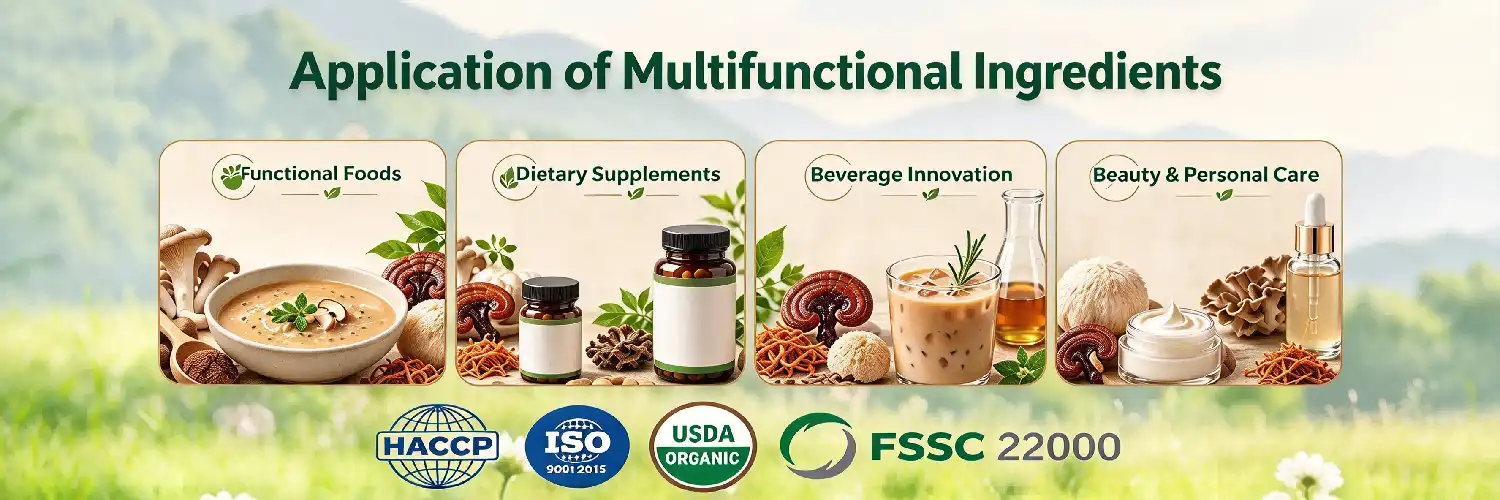
If a factory gets GMP, ISO22000, HACCP, or HALAL certification, it means they follow written procedures, do internal audits, and keep records that people outside the factory can see. The licenses aren't just for show; they show that the systems are working right and always giving the same results.
Comparison and Selection: Choosing the Right Extract for Your Business
G. lucidum comes in a number of different forms. What you want to use it for will determine which one is best for you.
So, here are the most important things for buying teams to think about:
- Active ingredient specification: High-polysaccharide extracts (30%–40%) suit immune-support capsules and functional beverages. High-triterpene extracts (15%–30%) are better positioned for antioxidant claims and hepatoprotective formulations. Dual-standardized extracts allow flexibility across both positioning strategies.
- Fruiting body vs. mycelium source: Fruiting body extracts yield a more complete triterpene profile and are generally preferred by markets with stricter labeling standards.
- Certification alignment: If your target market is the U.S., FDA GRAS compliance and GMP certification are the minimum baseline. Organic certification adds credibility but raises raw material costs.
- Particle size and mesh specification: For capsule filling and tablet pressing, 65–80 mesh powders provide good flowability. Finer powders (80–100 mesh) suit beverage applications where rapid dissolution is required.
These differences mean that people who buy things can pick where to buy them based on features instead of just price. When you buy a fully approved, dual-standardized extract that costs a little more per kilogram, you usually get better labels, less work that needs to be redone, and fewer lots that need to be turned down.
Procurement Tips for B2B Clients: Buying Bulk Reishi Extract with Confidence
You take a chance when you agree to buy in bulk without first learning more about it. At every point in the supply chain, these steps will keep it safe.
Verify Before You Commit
If someone wants to buy Reishi Mushroom Extract Powder, they should have a current Certificate of Analysis (CoA), any ISO certificates they need, and GMP papers. There should be as many tests as possible to back up the CoA. Before teams buy Reishi Mushroom Extract Powder, they should find out how many carbs and triterpenes it has. It should also be clear how the tests will be carried out. Things might not turn out the same if you compare them in different ways. If someone sells you something, make sure they always do it the same way. To prove that the Reishi Mushroom Extract Powder works as claimed, get the right HPLC data and test the triterpenes. If they can't give you enough reasonable proof, they might not be telling you the whole truth. How do you make sure there isn't too much pollution? How does the powder get tracked? How can you be sure that each batch is the same level of quality? All of these things should be known by people who want to use Reishi Mushroom Extract Powder to make things. You should read these papers very carefully if your business wants to buy Reishi Mushroom Extract Powder. Make sure you understand everything that's important. Also, their service providers will have a better idea of the high standards they need.
Use Pilot Orders Strategically
The first order should be small, usually between 5 and 25 kg. This way, your lab can compare the COA from the seller to the quality of the goods that are coming in. If the results match, it means that what you get is the same as what the provider tested. Talk about any big changes in the microbiological state, the amount of water present, or the levels of active chemicals before you scale.
Storage and Logistics Considerations
There is water that can be held in reishi powder. Large orders are put in 1 kg metal foil bags, and small orders are put in 25 kg fibre drums. The samples won't get wet while they're being sent this way. It will work fine for 24 months if you keep it at room temperature in a cool, dry place where the humidity is less than 65%.
Conclusion
People who want to buy Reishi Mushroom Extract Powder should see proof that it does what it says it does. Some of these are how well it dissolves, how stable the active ingredients are, and how the powder changes from one batch to the next. These help the business make sure the product always does what it's supposed to do and follows the steps. The cell wall of the Reishi plant is used to make a well-known powder. You can test it in a number of ways. Triterpene molecules can be found with UV-visible spectroscopy and HPLC. Both of these ways will work if you follow them correctly. If someone buys something from a supplier, they should check that the seller's GMP records, related ISO certifications, and Certificates of Analysis for each batch are correct. You can be sure that the ingredients are good if you use an extract that has clear rules for polysaccharides and triterpenes. If someone sells Reishi Mushroom Extract Powder, they should be open about how they make it, test it, and keep the quality high. Firms can try out small amounts of mixes to see how well they mix, taste, process, and work with other things before they order a lot of them. It helps them find the best Reishi Mushroom Extract Powder for their business that they read about it and using it in their own recipes. This will help them keep working in the long run.
FAQ
What is the standard polysaccharide content in a quality Reishi extract?
UV spectroscopy always shows that the polysaccharide content of Ganoderma lucidum is between 20% and 40%. If an extract has less than 20%, it might come from mycelium or use raw materials that have been processed less. Most of the time, they don't work as well when mixed with other things.
How do I verify triterpene content before purchasing?
Request an HPLC Certificate of Analysis that clearly displays the precise quantity of ganoderic acids that were discovered. UV light can change the way other chemicals work, so claims about triterpenes that are only based on UV light are not as true. If you ask, any reputable company that sells fruiting body extract will be able to give you HPLC results.
What particle size works best for beverage applications?
For ready-to-drink drinks and pills that dissolve, a powder with an 80 to 100 grit works better with water. Some 65-mesh extracts work better in pills and tablets than in drinks. This could mean that they need more work or something to spread them out.
What certifications should a U.S.-market supplier carry?
They have to follow GMP, ISO22000, HACCP, and FDA GRAS rules at the very least. If HALAL says it's okay, you can reach more people. Organic certification doesn't mean you have to do it, but it does give you more ways to sell your product in the natural health market.
What is the recommended shelf life for bulk storage?
An extract with less than 5% water will work properly for 24 months as long as it is kept in sealed aluminium foil or fibre drum packing.
Partner with EXTRABROC® for Certified Reishi Mushroom Extract Powder
EXTRABROC® supplies pharmaceutical-grade Reishi Mushroom Extract Powder—dual-standardized for triterpenes (1%–30%) and polysaccharides (20%–40%)—sourced exclusively from the Ganoderma lucidum fruiting body. Backed by 13 years of plant extract expertise, a PhD-led R&D team, and full GMP, ISO22000, HACCP, and HALAL certification, we support B2B manufacturers from pilot sampling through large-scale commercial supply. Contact our technical team today at info@extrabroc.com or visit extrabroc.com to request a Certificate of Analysis or discuss custom specifications.
References
1. Boh, B. et al. — Ganoderma lucidum and its Pharmaceutically Active Compounds. Biotechnology Annual Review, 2007.
2. Wachtel-Galor, S. et al. — Ganoderma lucidum (Lingzhi or Reishi): A Medicinal Mushroom. Herbal Medicine: Biomolecular and Clinical Aspects, CRC Press, 2011.
3. Ferreira, I.C.F.R. et al. — Anti-inflammatory Effects of Polysaccharides from Ganoderma lucidum. Food Chemistry, 2015.
4. Liu, X. et al. — Standardization and Quality Control of Ganoderma lucidum Extracts. Journal of Ethnopharmacology, 2016.
5. Chen, S. et al. — Triterpenoids from Ganoderma lucidum: Extraction, Characterization, and Bioactivity. Phytochemistry Reviews, 2012.
6. U.S. Pharmacopeial Convention — Dietary Supplements Compendium: Ganoderma lucidum Fruiting Body Standards. USP-NF, 2021.