Sourcing Natural Beta Carotene for Food and Animal Feed Production
Sourcing Natural Beta Carotene for Food and Animal Feed Production starts with five checks: the source and production method, the format, the purity and test method, the certifications for your target market, and the supplier's ability to ship consistent batches. In the United States, buyers also confirm that each grade fits its intended use, because food color, dietary supplement, and animal feed products follow different rules. We recommend requesting specifications, certificates of analysis, and samples before any bulk order. This guide covers each step and explains what FuYNature Natural Beta Carotene 96% crystal offers.
As a buyer, you probably juggle clean-label demand, tight margins, and strict US rules. Natural Beta Carotene sits at the center of those pressures. It colors food, adds provitamin A value in suitable products, and supports antioxidant positioning. A good purchase still depends on more than availability. Source transparency, standardized potency, stability, documentation, and supply continuity all count. We wrote this guide from the viewpoint of a supplier who answers these questions every week.
Understanding Natural Beta Carotene Before You Buy
Let's start with the basics, because the source and method shape every later decision.
What Is Natural Beta Carotene?
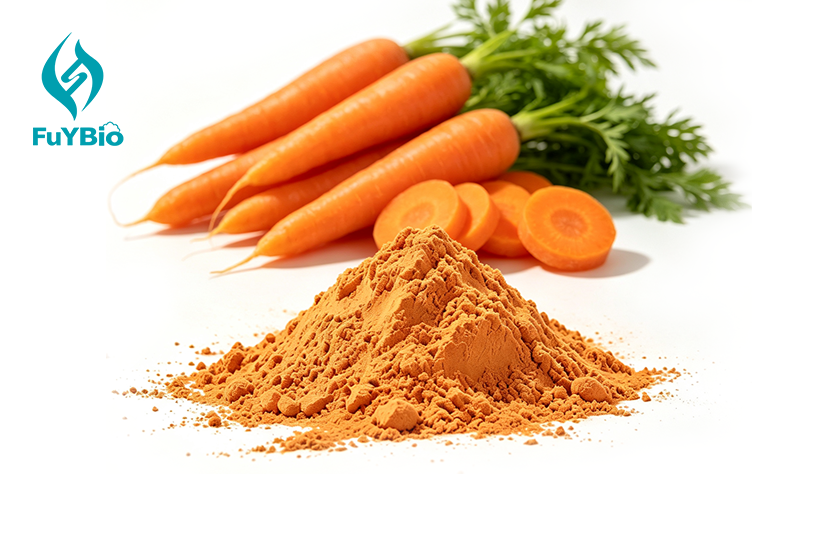
One kind of carotene is beta carotene. Onions, carrots, and some types of palm fruit are this color. Nutritionists call it a "provitamin A chemical" because the body can change it into vitamin A when it needs to. It is not necessary to use chemicals made in a lab to make Natural Beta Carotene. A lot of people get it from the fungus Blakeslea trispora, the microalgae Dunaliella salina, and the oil from palm fruit. The label, the stability, the cost, and the color shade all depend on the source. Another difference between retinol and beta carotene is that retinol is made by the body, not the other way around. People who buy from us are told not to just believe what the label says, but to look at the source, the method, and the natural-status papers as well.
Natural Beta Carotene Sources, Extraction, and Manufacturing
The steps are usually easy to follow: grow the algae or fermentation culture, get the biomass, concentrate it, get the color out of it, clean it, and make sure everything is the same. It can be sent as oil mixed with crystals, powder, beads, or softgel fill. Every batch is the same because fermentation happens in controlled tanks. But when algae grow in an open pond, the weather and season can make a bigger difference. It is a deep orange color because it has a long chain of double bonds that are joined together and soak up light at 450–480 nm. Light, air, and heat all change that building in the same way. Talk to each source about how to pack, test for toxins, keep track of, stop rusting, and enclose.
Comparing Natural and Synthetic Beta Carotene
There are more things to compare than just natural and artificial ones. Also, think about what will be done with the item after it is made. Gasoline and oil are mostly used to make this all-trans form of beta carotene. The 9-cis form is found in varying amounts in natural sources. People say that Dunaliella has the most. There are various kinds of HPLC tests that can tell the difference. It's also important where you stand. If the brand has a good name, natural-status papers might be needed. On the other hand, if the premix is driven by price, price might be more important. You can turn Natural Beta Carotene into vitamin A. It is a type of carotene. Make sure you read the package and are comfortable with the amount and promises if you want to use it instead of vitamin A. How much does it cost per effective amount or color unit? Check out how stable the colors are and how well they work.
Matching Natural Beta Carotene to Your Product Format, Use, and Dose
Once you know the source, the next question is where the ingredient will go and in what form.
Selecting the Right Natural Beta Carotene Format
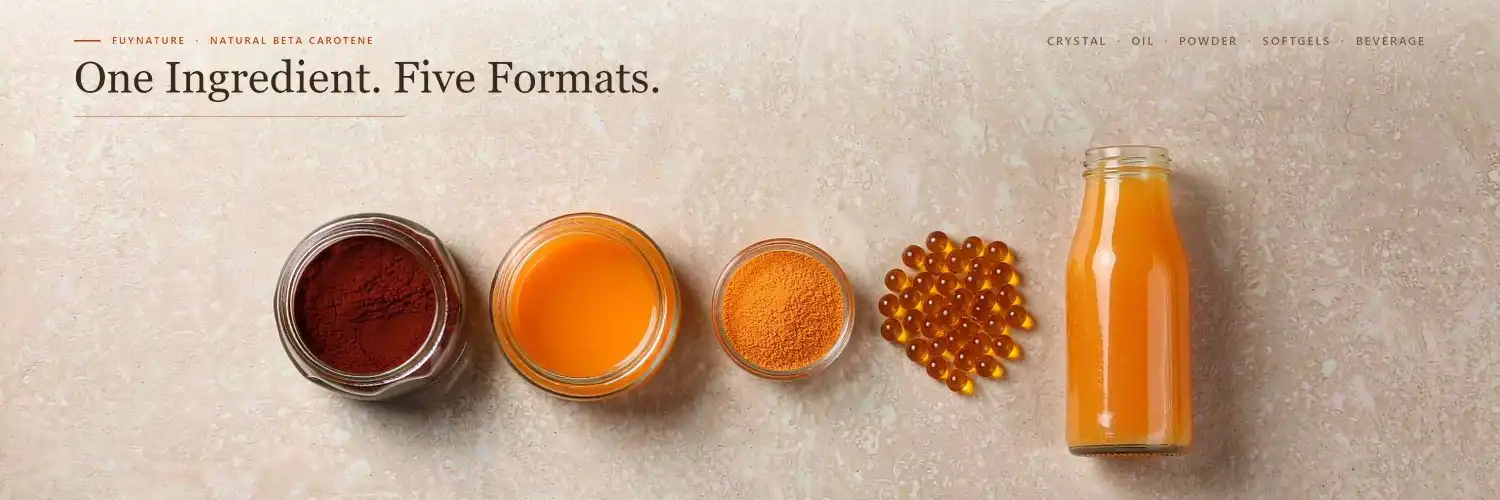
Natural Beta Carotene can come in many forms, such as beads, pills, oils, powders, and softgels. It is possible to use oil suspensions in softgels, lipid systems, and some types of feed. Powders and beadlets can be used in drinks, healthy foods, pills, and dry mixes. Before you decide, you should think about the carrier, processing temperature, how sensitive it is to moisture, the equipment, and the shelf life. A lot of the things that FuYNature sells are crystals. Our 10% microcapsule powder and 30% oil solution can be used in various production lines. Price per kilogram and cost of use as a whole. Make sure the provider can help with formulation, packing, labels, papers, and market registration. This will help you decide if they can help with private-label or OEM projects.
Natural Beta Carotene Applications in Food and Animal Feed
Natural Beta Carotene is added to drinks, baked goods, candies, ice cream, and sauces to make them look better. Plus, these foods have more vitamin A because of it. Softgels, pills, and powder mixes made from it are made with other things. When some brands talk about beauty from the inside out, they also talk about skin health. The recipe papers for these brands also talk about vitamins, the eyes, and the immune system. But all claims have to follow the rules for labels in the US. There are more questions about which species can be used, how much to add, whether the feed will mix with the matrix, and how stable it will be after being stored for feed and premix projects. People in the US follow the rules set by the FDA and the AAFCO when they talk about ingredients. Color and nutrition grades should always be kept separate because the strength, assay, and spread of the color can be different. We go over every feed question with the buyer before giving them a score.
Absorption, Dosage, and Safety Considerations
The type of beta carotene that is taken in depends on the amount of fat in the food, how the particles are packed, and how they are spread out. Forms that break down in water and forms that break down in oil might not work the same way in the same product. One microgram of retinol activity equivalent (RAE) is equal to twelve milligrams of beta-carotene in food. This is what the National Academies say to do to find activity in vitamin A. If you want to color, feed, boost, or add to food, you need to use the right amount for each purpose. There are different levels and rules for each. For a short time, your skin turns yellow-orange when you get too much vitamin A. It's not the same. The ATBC study also discovered that men who smoked and took 20 mg of the supplement had a higher chance of developing lung cancer. This is proof that supplement teams should look at. Do not say yes until you have read papers on safety, allergens, contaminants, stability, and safety.
Evaluating Suppliers and Building a Dependable Sourcing Process
A clear ingredient choice still needs a supplier who can deliver it again and again. These four steps help you decide.
How to Compare Natural Beta Carotene Suppliers
Price doesn't tell you everything. Find out how big the plant is, how clear the sources are, how consistent the batches are, the quality systems, licenses, legal support, technical skill, wait time, and how they plan to keep the supply of Natural Beta Carotene. Need papers that are safe or kosher? You can ask each provider for them. They need to have information about the product's safety, its stability, its pollution results, its place of origin, and how it was made. Then just ask them. Where does it come from? How do you make it? How does the normal amount look? What kinds of samples and files are out there? How many in-stock items do you need? How many can you make in a year? Could I talk to the seller about it? Does the company take your own labels? You can compare the results fairly if they are written on a sheet with weights.
Building a Dependable Sourcing and Quality-Control Process
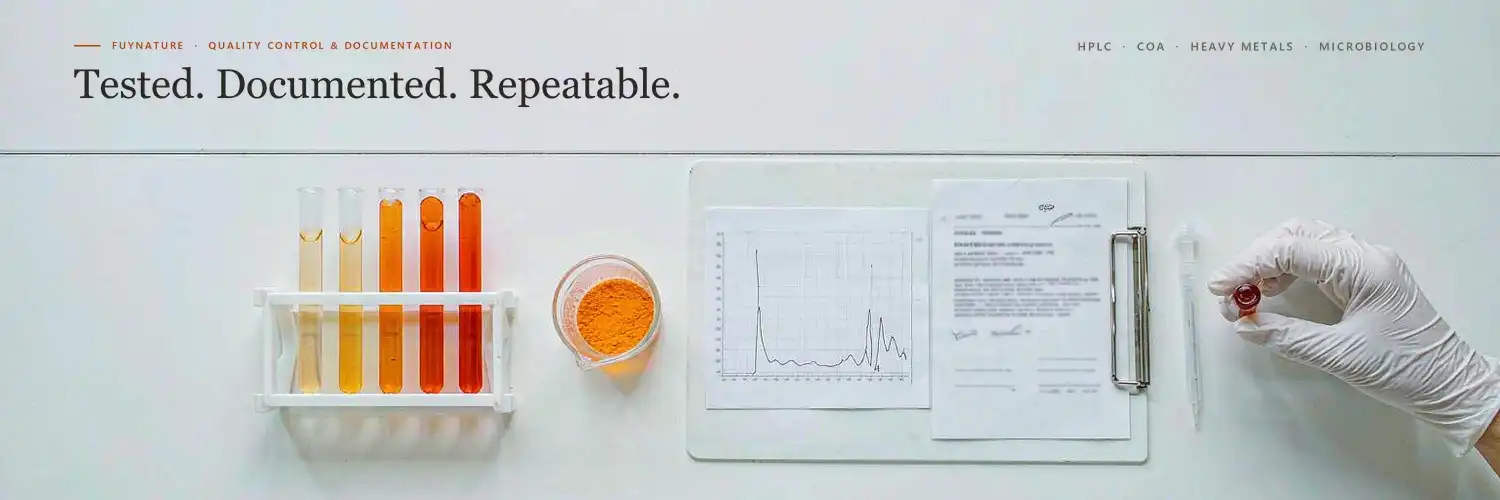
A clear written brief must be present before a reliable process can begin. This brief should include the objective, style, color scheme, certifications, packaging, and acceptance requirements. Next, get forms and examples from different types of groups. Then you should do lab and pilot tests to see how the color spreads, how strong it is, how it smells, how it tastes, how long it stays stable in tests, and how it reacts to heat, light, oxygen, and pH. To check the quality, you should usually do an HPLC test, a gas chromatography test for leftover solvents under USP <467>, a peroxide value test, an ICP-MS test for heavy metals, and a microbial screening. As long as the seller agrees, reports, traceability checks, and reviews of corrective measures can be added. Once you've bought a lot, you should check every new lot that comes in to see if it has microbes, contaminants, and is stable.
Managing Cost, Logistics, and Long-Term Supply
The price of an item changes based on where Natural Beta Carotene was made, how it was made, what format it is in, how stable it is, any certificates it has, how it is packed, your order number, and any special requests you may have. That's not all you should look at. You should also look at the cost per active amount, color unit, or overall output. This is because a 96% crystal and a 10% powder have very different amounts of the active ingredient. When buying in bulk, you should think about the wait time, payment terms, minimum order quantity (MOQ), shelf life, inventory turnover, and shipping rules. Natural Beta Carotene can be changed by heat, light, oxygen, and water. Because of this, you should ask about shipping and packaging controls, such as whether the goods can be sent by air or sea freight. Things like regional concentration, backup output, emergency allocation, and change-notification deals can help you get what you need for a long time.
Common Sourcing Mistakes to Avoid
Buyers keep making the same mistake. Some people will only buy something that says "natural" on the package. Not everyone reads the fine print, checks the end product grid, or checks to see if the product is allowed in the target market. Some people only look at the prices. Where the grades come from, how they are transported, how stable they are, how strong their colors are, and how long they last are all things that can tell you a lot about them. That is, an oil that works well in a softgel might not work so well in a drink, a dry premix, or a process that needs a lot of heat. It's easy to fix. Test things in the lab and on a small scale before you order a lot of them. It's important to read the papers and rate providers based on written technical, legal, quality, and service standards before you start making a lot of things. Most of the time, skipping these steps costs more than taking them.
FuYNature Natural Beta Carotene 96% Crystal at a Glance
Here is how our product fits the checks above.
Specifications and Certifications
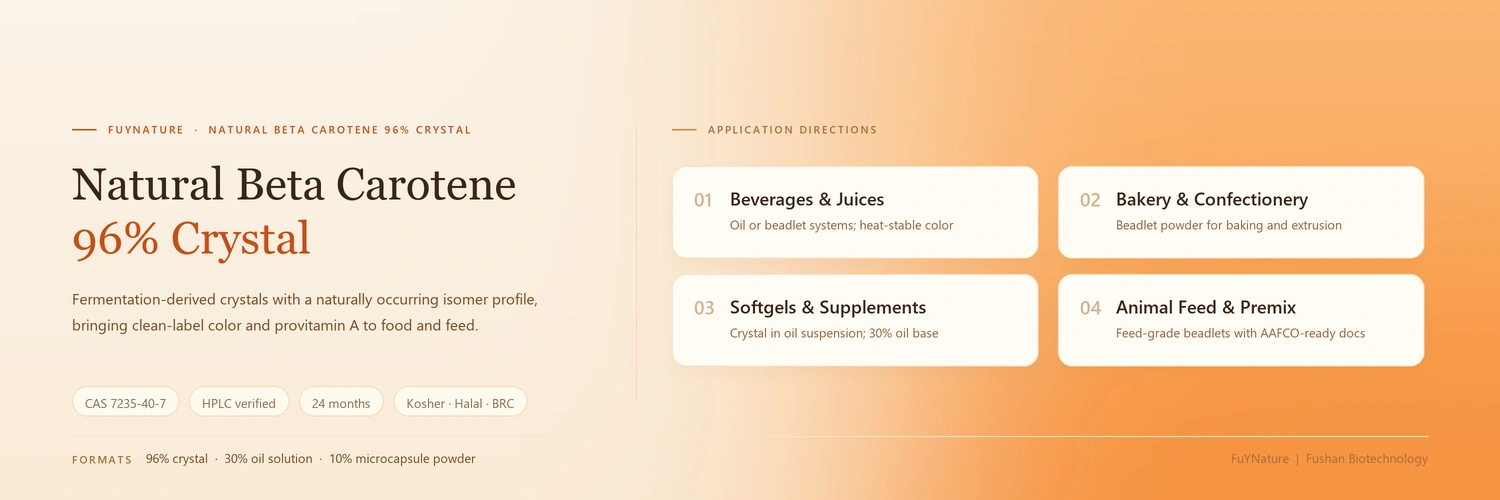
A 96% cube of FuYNature Natural Beta Carotene is made with yeast. The crystals are a dark red to brownish-red color and are beta carotene (CAS No. 7235-40-7). We check them with HPLC. Heavy metals and germs won't affect it, and you can store it for 24 months. We have the ISCC Plus, BRC, Kosher, Halal, ISO9001:2015, and VeganSu certifications. The audit and quality teams can look these over. The ingredient comes from fermentation and has a good mix of naturally occurring isomers that help functional foods, nutraceuticals, and supplements have clean labels.
Customization, Stock, and Shipping
You can request a 30% oil solution, a 10% microcapsule powder, or a 96% crystal. We can also change how much of the active ingredients you get to make your blend work. You can place large orders with us because our production capacity is stable, and we respond quickly and ship within 3–7 days. This lets you plan your production. Our team can help you develop new technologies and change recipes. We can take care of freight by air or sea. In real life, the same place can be used by a company that makes drinks, softgels, or premix.
Why Work with FuYNature?
FuYNature has long been dedicated to functional nutrition. Our partner facilities hold GMP, ISO22000, HACCP and HALAL certifications. We not only supply raw materials, but also provide scientific evidence, formulation solutions and compliance support services. This enables your team to receive assistance with both literature backing and market implementation at the same time. Our years of research on Nrf2 based on broccoli seed extract have reshaped our understanding of evidence validation and quality.
Conclusion
How can people find Natural Beta Carotene that they can use in food and animal feed? First, they should say what they plan to use it for. Then, the source, style, and files should all fit that purpose. Different isomers are found in different places and at different rates in the fermentation, algae, and palm paths. These are some more ways that natural and synthetic grades are not the same. Because oil, powder, and crystal forms react differently in softgels, drinks, and premixes, tests need to be carried out in the real matrix. How well something is taken depends on the fat and how it is made. People were scared when high-dose vitamins were studied. In other words, use is connected to amount and review of safety. Price, certifications, HPLC data, capacity, and lead time are some of the things you should look at when you compare suppliers. Step-by-step tests in the field, inspections when they arrive, and samples are all parts of a process that lowers risk. People don't make common mistakes like believing the word "natural" by itself when there are clear criteria ahead of them.
FAQ
How do I choose a source for Natural Beta Carotene?
To begin, choose the type of thing and the goal. But you can control how much food is made with fermentation in tanks. In other places, algae and palm sources work better. Before you make a choice, ask for source papers, HPLC data, and analysis records from batches that are meant to be the norm for Natural Beta Carotene.
Is Natural Beta Carotene suitable for animal feed?
The species, the feed grid, the rate of addition, and the rules in the area may all make that possible. Before you buy a lot of things in the US, make sure you know what the FDA and AAFCO want. Also, get documents that are good for feed and keep your premix for a while.
Should I choose oil or powder?
Pick oil if you want to make softgels or systems with fat. For dry blends, premixes, and drinks, powder or beadlets work best. Because the same ingredient can act in different ways in different matrices, you should test the stability, color strength, and spread in your real process.
Do you support formulation and customization projects?
We can help you with technology, change formulas, and change current materials. Next, write down who you're writing for, how long it should be, and what style it should be in.
Request FuYNature Natural Beta Carotene Samples and a Technical Quote
Want to buy Natural Beta Carotene from a business that can quickly answer your technical questions? Write FuYNature an email about your item and the people you want to buy it. Type, amount, certifications, number, packing needs, and start date should all be included. You will be given information, samples, records of analysis, and official documents. You will also be helped to choose the right grade. You can email info@extrabroc.com or go to extrabroc.com to talk about that.
References
1. National Academies Press, Dietary Reference Intakes for Vitamin A, Vitamin K, Arsenic, Boron, Chromium, Copper, Iodine, Iron, Manganese, Molybdenum, Nickel, Silicon, Vanadium, and Zinc, 2001
2. New England Journal of Medicine, The Effect of Vitamin E and Beta Carotene on the Incidence of Lung Cancer and Other Cancers in Male Smokers, 1994
3. Annual Review of Nutrition, Bioavailability and Bioconversion of Carotenoids, 1998
4. Current Opinion in Food Science, Natural Food Pigments and Colorants, 2016
5. Birkhäuser, Carotenoids Handbook, 2004
6. U.S. Food and Drug Administration, Code of Federal Regulations Title 21, Part 73: Listing of Color Additives Exempt from Certification, 2024