Natural Beta Carotene for Dairy, Bakery, and Confectionery Manufacturers
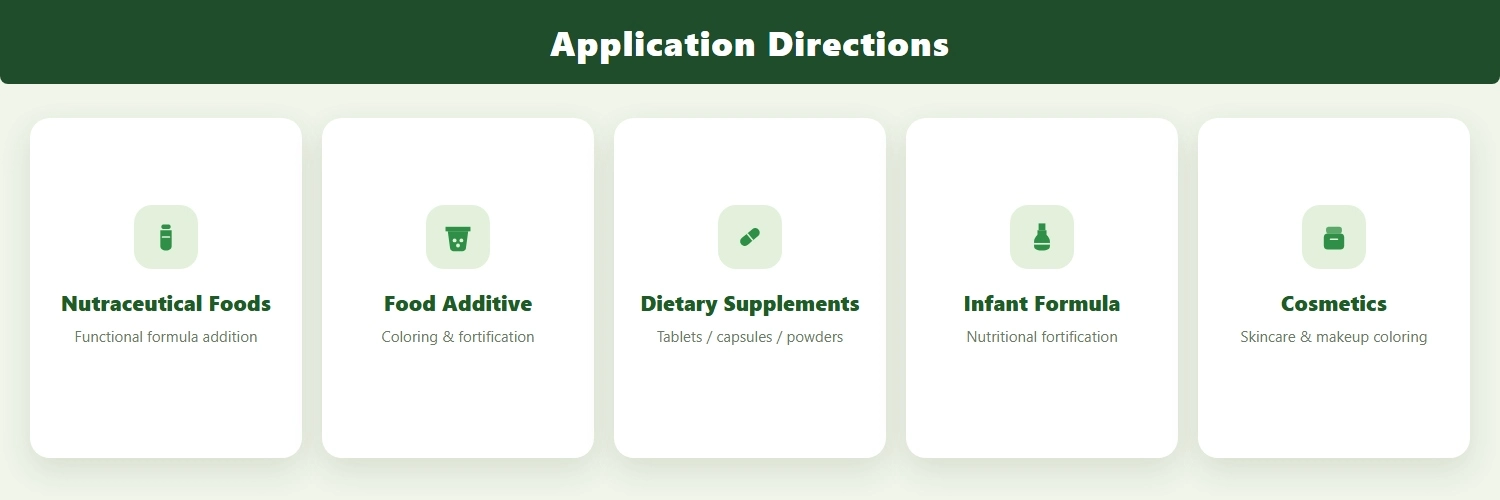
Natural Beta Carotene gives dairy, bakery, and confectionery manufacturers a yellow-to-orange colorant that supports clean-label products and, in approved applications, adds provitamin A. It works best when you match the format to the food matrix: oil-based preparations suit fat-rich products, while powders suit dry blends and premixes. Success depends on batch consistency, heat and light stability, dispersion, dosage, and documentation. In this guide, I explain how Natural Beta Carotene is made, how to choose between powder and oil, how to validate it before production, and what to ask a supplier before a large order.
Why Natural Beta Carotene Fits Dairy, Bakery, and Confectionery Products?
Why Are Manufacturers Switching to Natural Beta Carotene?
In the U.S., a lot of people read food labels, and a lot of brands have switched from fake colors to chemicals that people know. With that change, Natural Beta Carotene functions well. It is yellow, gold, and orange because of its carotene color. This color is also turned into vitamin A by the body. The shade range is well known because omega-3 has been in cheese, butter, and margarine for a long time. The move still needs to be planned. It's important that the paperwork is stable when it's hot and stored, and that the color stays the same from batch to batch. Since they haven't said what "natural" really means, I think the FDA should check every claim on food labels.
What Is Natural Beta Carotene?
Other carotenoids, like Natural Beta Carotene (C40H56), are close to fat. Hexane is orange because it has a long chain of double bonds that are hooked up. These bonds soak up light between 450 and 480 nm. Some of the things that are used to make it are charcoal, carrots, palm tree parts, or fermentation with fungi like Blakeslea trispora. What it is made of, how it dissolves, how much it costs, and what color it is are all affected by the source and method. Some labs make Natural Beta Carotene in the all-trans form, but you can also find it in nature in the cis form. Food coloring grades, nutritional premixes, and supplement ingredients need to be labeled in different ways, so people who buy food should keep them separate.
Benefits in Dairy, Bakery, and Confectionery Products
The color is the first good thing. Apple sauce, butter, ice cream, plant-based dairy, cakes, sauces, treats, and coatings all stay a stable yellow, golden, or orange color because of Natural Beta Carotene. The second question is where to put the label, since carotene can be used instead of made-up colors in many recipes. The third is food and health. The Institute of Medicine says that 1 microgram of retinol activity is equal to 12 micrograms of Natural Beta Carotene in food. This means that vitamin A isn't very important, but it does matter how much you take. You should choose early on whether your goal is color, strength, or both. This will give you your exact dose and information.
Natural Beta Carotene Applications and Format Selection
Dairy and Plant-Based Dairy Uses
There is a lot of fat in dairy products, and the lipid phase is where Natural Beta Carotene breaks down quickly. Blenders that use oil are often used to make butter, margarine, cheese, and ice cream. Soda, milk drinks, and plant-based drinks all use kinds that can be mixed with water. You shouldn't just use a color chart; you should also test it in your own base first. Acidity, protein amount, and temperature at which the food is pasteurized can all change the color at the end. Because dairy and plant-based foods don't naturally have yellow in them, Natural Beta Carotene helps make up for it. Also, pack things that won't let light through, since store light makes clear bottles and tubs fade quickly.
Bakery and Confectionery Applications
Anything that is air, heat, wet, acidic, or under pressure can damage the colors in baking and candy recipes. In foods like cakes, cookies, sauces, custards, glazes, sweets, gummies, caramels, and coatings, the color is more or less important. The format that was chosen needs to stay the same color while it bakes, cools, and is sent somewhere else. It would be good to see how well the color works with fats, proteins, starches, emulsifiers, and hydrocolloids in the pilot tests. You should also look at the final shade and how strong the color is. The best coats that look like chocolate are made with oil. Candy and sugar decorations, on the other hand, need a shape that can be broken down in water. Now that baked goods can use coated powders and emulsified preparations, they have more batters and premixes to choose from.
Natural Beta Carotene Powder vs. Oil
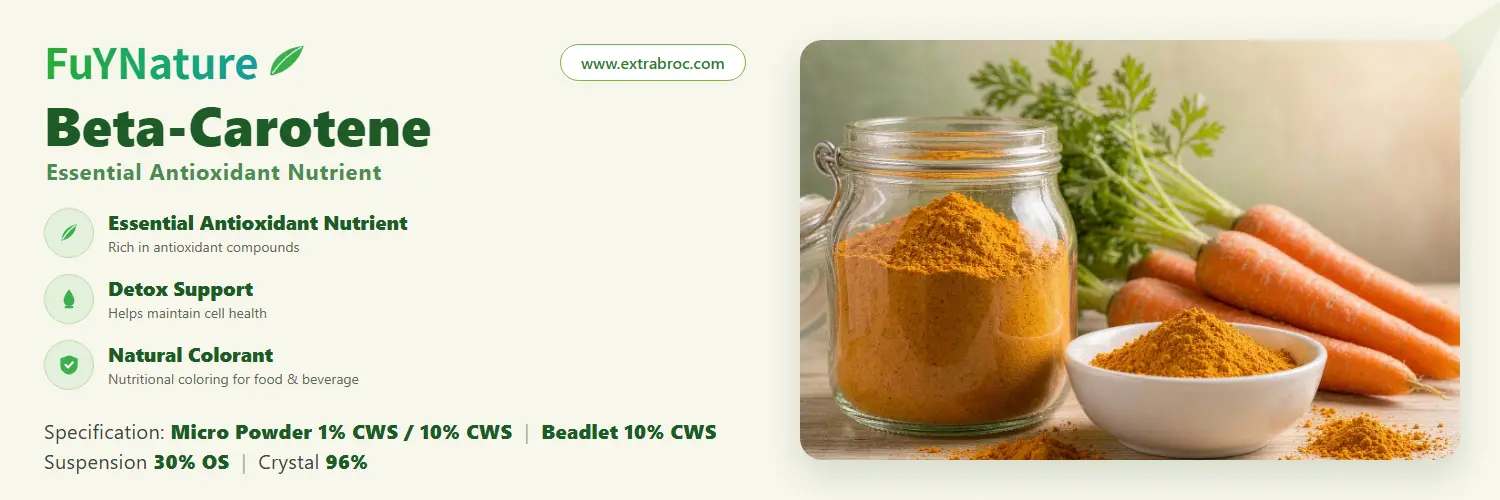
The style you pick for Natural Beta Carotene should depend on the product grid and how the doses are given. Butter, margarine, and chocolate sauces that are oil-based work well with oil-based recipes because they are easy to spread in the fat phase. For dry mixes, quick foods, and bake mixes, powders work better. Spray-dried, encapsulated, and carrier-based powders are not all the same when it comes to how well they protect, flow, and spread. You should check a bulk ingredient's wetness level, particle size, container makeup, concentration, and ability to work with automatic feeds before giving it the go-ahead. Our product description says that 10% of it is microcapsule powders and 30% is oil solutions. They are good places to start for teams that work with cheese, baked goods, and sweets.
How Is Natural Beta Carotene Made, Stabilized, and Specified?
How Is Natural Beta Carotene Made and Stabilized?
Almost everything starts with a plant or animal. Next, the plant or fermentation must be used to get the carotenoids. After that, the stuff will be standardized, cleaned, and concentrated before being turned into crystals, oil, powder, or a mix of the three. It can be made by anyone, and the same people can do it over and over on a large scale. Oxygen, light, heat, water, and some metal ions can all change Natural Beta Carotene. Suppliers use oxygen-barrier packaging, antioxidants, spray drying, microencapsulation, and containers that don't let light through to make sure this doesn't happen. Reviews like the one by Delgado-Vargas and friends talk about these things. Carotenoids are broken down by them. People who want to buy something should not only look at the shelf life, but also ask for stability data that shows how the product is actually handled, shipped, and stored.
FuYNature Natural Beta Carotene 96% Crystal Specifications
This is information about our fermentation-derived ingredient:
| Item | Specification |
|---|---|
| Appearance | Dark red to brownish red crystal |
| Specification | 96% crystal |
| CAS No. | 7235-40-7 |
| Test method | HPLC |
| Shelf life | 24 months |
| Heavy metals and microbiology | Meets standards |
| Technology and origin | Fermentation, China |
| Certifications | GRAS, NSF GMP, ISO9001:2015, Kosher, Halal, BRC, FSMA, VeganSu, ISCC Plus |
They are very strong, so food plants mix them with oil or turn them into a powder before giving them to animals. You can tell us what amount of active ingredient you need, and we can handle large orders because our output stays steady.
Quality Control Checks Buyers Should Expect
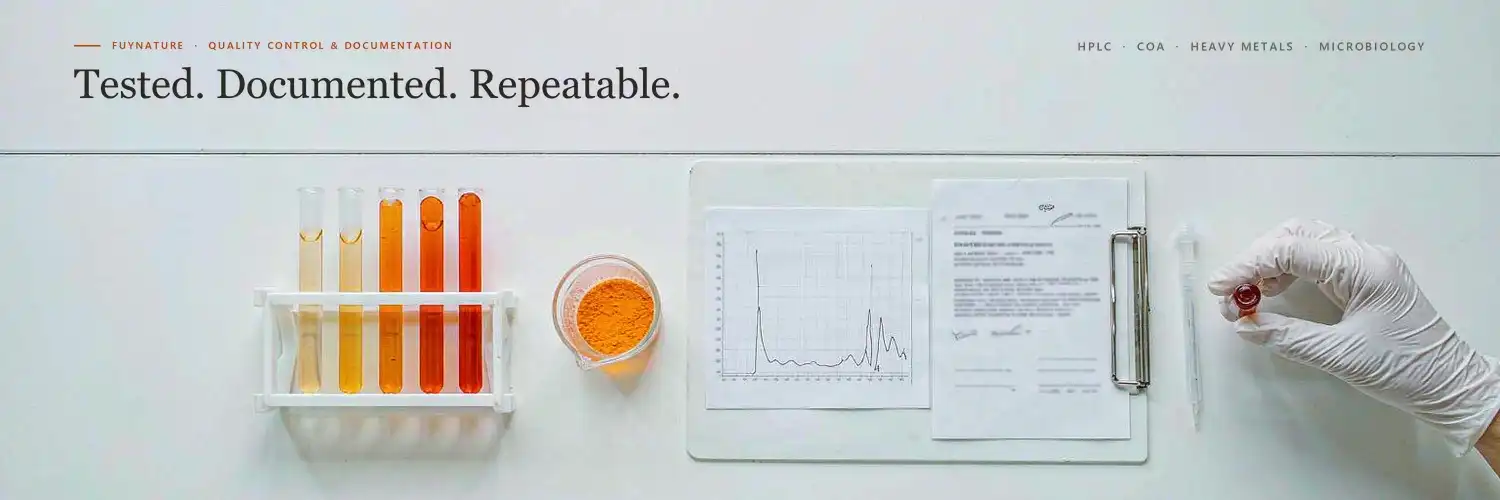
There should be more than one number checked in a good program. For sure, the concentration and isomer profile from the other test are correct with an HPLC assay. Gas chromatography is used to see if USP <467> is mixed with any liquids that are still there. The number of peroxides tells us how stable an oxidation state is. Lead, arsenic, mercury, and cadmium are all checked for by a machine called ICP-MS. It also looks for yeast, mold, and E. Both Salmonella and E. coli. The way the bits are spread out and how well they mix with cold water can also change how well powders and beads work. Our rule says that HPLC is the best way to carry out the test. Heavy metals and bacteria are also okay according to the rules. That way, your team can see how the results stack up against the limits for new materials. Ask for the full COA for each lot.
Dosage, Problem Prevention, and Validation
Dosage, Absorption, and Formulation Guidance
How to find the right dose? Think about the job that needs to be done, the color that is wanted, the amount of waste that will be made, and the market's rules. You should have different goals for the amount of color and the amount of strength. According to 21 CFR 73.95, Natural Beta Carotene is a color additive that doesn't need a license in the US as long as it is used in a way that is good for manufacturing. If most of your body is water, choose forms that can be mixed or combined with water. Then, add forms made from oil to the fat phase first. It's easier to take in food that is fatty, broken up into small pieces, and well mixed. The 1994 ATBC study found that men who took supplements with a lot of Natural Beta Carotene were more likely to get lung cancer. If someone says something is stronger, it needs to be checked by trained regulatory experts.
Common Problems and How to Avoid Them
Things that go wrong most of the time are color that isn't even, fading during storage, bad distribution, the wrong file, and costs that are higher than expected. Heat, air, light, moisture, metal ions, the wrong dose, bad mixing, and different amounts are some of the things that can cause this. It is safer to use standard ingredients, set color goals for instruments, mix the colors in the same order every time, pick stable forms, and check each batch as it comes in. You don't see the costs when you only look at the price. Because more of a weaker, cheaper ingredient has to be used, there may be loss, the need to mix it again, or production delays. You should look at the total cost, which should include things like technical support, stability, concentration, and a steady supply.
How to Validate Before Commercial Production
There are three steps to this. To begin, test the goal shade, color strength, dispersion, matrix compatibility, and dose in the lab to see how they differ. Second, test the product in a way that is as close as possible to how it will be cooked, mixed, cut, cooled, and packed in a business. Third, study the shelf life right away and in real time. Pay attention to how the food stays colored, changes in smell, separation, movement of moisture, and how the packaging affects these things. When you test the last sale pack, the data is different. Getting help with your apps can help you choose samples, change the recipe, write up information, and grow your business. Sometimes things go wrong during production, or the goods on the shelf won't be the same. An organized method makes it less likely that this will happen.
Choosing a Natural Beta Carotene Supplier
How to Evaluate Technical and Commercial Capability?
Find a source based on how well they know their stuff and how well they can meet the needs of your business. You should be able to show where the product comes from, how concentrated it is, if it is food-grade, how much it can make, how consistent each batch is, what certifications it has, how long the wait time is, and how it handles shipping to other countries. As an OEM, you might be able to get better technical help, customization, and control from a straight maker or its sales arm. What about a wholesaler? They might have stock nearby, take smaller orders, or offer service in your area. In addition to a specification sheet and a certificate of analysis (COA), you should also get allergy and GMO statements, food safety certificates, stability data, and contaminant tests. The food's origin should also be known. Not just the weight-based price; add up all the costs. The real number might be different depending on yield, freight, dosage efficiency, and the advice of a professional.
Procurement Checklist
A checklist can help you make a clear list of the tech things you need. It is important to look at the grade, source, use, amount, security, way it is stored, style, dosage, transport, and packaging. Look at the food's origin, microbiological results, allergen and GMO labels, and the certificate of analysis (COA). You should also look at any heavy metal or pesticide information. There is a minimum order quantity (MOQ), price ranges, yearly capacity, wait time, freight costs, payment terms, and backup supplies that you should look at next. When you work on OEM or private-label projects, make sure you can get models and that the label can be made. It should also be legal in the market you want to reach. Our quick response time of 3–7 days helps you plan when to start making things. We can ship goods by air or sea.
Why Work with FuYNature ?
FuYNature is backed by an R&D team led by four PhDs. We have filed 54 invention patent applications in the US and other regions, of which more than 30 have been granted. We have been engaged in functional foods for 13 years, and our production site holds GMP, ISO22000, HACCP and HALAL certifications. In addition, we provide scientific support, solution planning, compliance consultation, process development and HPLC testing services. Dedicated contacts are assigned for dairy, baking and confectionery lines to handle specification alignment, sample development and scale-up production.
Conclusion
Cheese, baked goods, and sweets are some of the foods that use Natural Beta Carotene. It helps labels look better and gives people the right amount of vitamin A. How it works is based on the food structure. If you want to make high-fat dairy or sauces, you should use oil-based recipes instead of powder-based ones. Not only the source but also formulation, sealing, packing, and processing can change how stable something is. Safety checks are done in the lab, on pilots, and on products that will last a long time. The amounts must be safe and follow U.S. rules. The color goals and fortification goals must also be kept separate. People who are buying something shouldn't just pick a source based on price per kilogram. Along with the total cost, they should also think about things like professional help, paperwork, credentials, focus, and so on. Before it can be dosed, a 96% rock has to be turned into oil or powder.
FAQ
Should I choose powder or oil for my product?
Fit the style to the grid. High-fat jams, margarine, butter, and spreads made with oil go well together. Powder can be used to make both dry blends and bakery premixes. For yogurt, drinks, and sweets, forms that break down in water work well. Do a test run first.
Does Natural Beta Carotene survive baking?
Heat, air, and light can all break down free Natural Beta Carotene. It's better to keep the color by putting things in shells or hardening them, but you should still check the results in your own oven and over time to be sure.
Which documents should I request from a supplier?
Find out where the food came from, what allergens and GMOs are in it, get a certificate of analysis (COA), stability data, contaminant reports, and make sure the food is safe to eat. You can find it on ISCC Plus, BRC, NSF GMP, ISO9001:2015, Kosher, and it says it is GRAS.
Can I use it for private-label or OEM projects?
Yes, most of the time, as long as the supplier lets you make changes, gives you packaging, helps you follow the rules, and has a good minimum order quantity. Talk to us about what you need.
Request FuYNature Natural Beta Carotene Samples or Bulk Quotations
Email us at info@extrabroc.com to talk to someone from Hefei Fushan Yuansheng Biotechnology Co., Ltd. about FuYNature Natural Beta Carotene. You can help us get ready by telling us what you need, what color you want, how much you want to print each year, what format you want, who you want to reach, and what certifications you need. When making cheese, baked goods, or sweets, do you need a Natural Beta Carotene source? Extrabroc.com has more information about the product and lets you ask about samples, documentation, customization, and buying supplies in bulk.
References
1. Institute of Medicine, Dietary Reference Intakes for Vitamin A, Vitamin K, Arsenic, Boron, Chromium, Copper, Iodine, Iron, Manganese, Molybdenum, Nickel, Silicon, Vanadium, and Zinc, 2001
2. The Alpha-Tocopherol, Beta Carotene Cancer Prevention Study Group, "The Effect of Vitamin E and Beta Carotene on the Incidence of Lung Cancer and Other Cancers in Male Smokers," New England Journal of Medicine, 1994
3. Delgado-Vargas, F., Jiménez, A. R., and Paredes-López, O., "Natural Pigments: Carotenoids, Anthocyanins, and Betalains – Characteristics, Biosynthesis, Processing, and Stability," Critical Reviews in Food Science and Nutrition, 2000
4. Schieber, A., and Carle, R., "Occurrence of Carotenoid cis-Isomers in Food: Technological, Analytical, and Nutritional Implications," Trends in Food Science & Technology, 2005
5. Rodriguez-Amaya, D. B., Carotenoids and Food Preparation: The Retention of Provitamin A Carotenoids in Prepared, Processed, and Stored Foods, OMNI Project, 1999
6. U.S. Food and Drug Administration, Code of Federal Regulations Title 21, Section 73.95, Beta-Carotene, 2024