Stachyose 80% Powder for Functional Food and Beverage Manufacturing
Stachyose 80% Powder is a white, plant-derived prebiotic powder standardized to at least 80% stachyose, tested by HPLC. For functional food and beverage manufacturers, it offers a low-sweetness oligosaccharide that dissolves in water, resists human digestive enzymes, and feeds beneficial gut bacteria. It fits yogurt, acidic drinks, powdered mixes, bars, and supplements, provided teams verify solubility, taste, and stability in their own formulas. Buyers should also review the certificate of analysis, packaging, shelf life, and supply capacity before approving a source. This guide explains those checks so your next prebiotic project moves from sample to production with fewer surprises.
This guide is prepared by the FuYNature team at Hefei Fushan Yuansheng Biotechnology Co., Ltd., with 13 years of expertise in functional nutrition.

What Is Stachyose 80% Powder?
Stachyose Chemistry and the Meaning of 80%
These four sugars are found in nature and are oligosaccharides in the raffinose family. There are three parts to it: two galactose units, one glucose unit, and one fructose unit. Finally, Stachyose is not a reducing sugar, which means it does not turn brown as quickly as that type of sugar does. Because our stomach enzymes can't break these chains, bifidobacteria and lactobacilli can eat it in the colon. The label that says "80%" means that the powder has at least 80% stachyose, which was proven by an HPLC test. The rest could be made up of different kinds of sugars, carbs, water, and ash. You now understand why I tell formulators to read the whole sheet of specs and not just look at the name of the product.
Product Specification at a Glance
A white powder called FuYNature Stachyose 80% Powder comes from China. It is used to take vegetables out of plants. It has to be at least 80% stachyose, as tested by HPLC, and it has to be good for 24 months. For microbiology and heavy metals, the standards are met. This is shown by certifications like ISO22000, HACCP, and HALAL. A steady 1,000 tons of work is done every year, which is enough to handle big orders. To mark foods as healthy, Stachyose is often used. It is a single part with a clear formula and molecular weight. Your quality team can then check to see if the results meet the standards they have set for good results. Ask for a lot of proof of the test and information about how the HPLC method works.
Physical Properties on the Production Floor
The powder called Stachyose is white and mixes well with water. It's clean and light, but not as sweet as sucrose. Because it is hygroscopic, it takes in water from damp air. It's very important how you store it. It should be kept in a room that is cool, dry, and below 25°C. The room should have a relative humidity of 60% and be sealed in a way that won't let water in. This ingredient's tech specs also show that it can stay stable in acidic environments (it works best between pH 2.5 and 4.0) and can handle normal heat treatment. The powder may not work the same way in your own matrix because of proteins, minerals, and hydrocolloids.
Stachyose 80% Powder Benefits and Functional Applications
Prebiotic Function and Gut Microbiota
It was agreed upon by the ISAPP in 2017 that a prebiotic is something that host bacteria choose to use to improve their health. This should be true for Stachyose since it doesn't break down. Instead, it goes to the gut, where bacteria change it into simple fats. A prebiotic powder called Stachyose 80% Powder is used in foods that are good for your digestive system. More bifidobacteria have been found in studies of Stachyose and other oligosaccharides like it that are found in soybeans. Still, it depends on the person and the dose. A claim like "ingredient-level study" shouldn't be put on the label until it's been looked over by a lawyer in the audience you want to reach. This is because a product's benefits come from its whole recipe and the amount that is eaten.
Beverage, Dairy, and Powdered Mix Applications
Stachyose 80% Powder is useful for foods because it doesn't taste sweet and is easy to mix in. You can choose acidic drinks and yogurt since math shows that they stay stable at low pH. Powdered drink mixes, bags, and stick packs all have the same amount of prebiotic fiber. Bars, baked goods, meal replacements, and plant-based dairy alternatives can all be used as long as they don't get too wet. In each case, you should check out how the water tastes, looks, and acts. A lot of teams start with a pilot batch that has two or three dose levels. Then, they choose the final dose by looking at how it tastes, how stable it is, and how well it works with their body.
Supplements, Synbiotics, and OEM Formulas
Because Stachyose works with probiotics, it makes sense for them to work together. When the live strains get to the gut, the prebiotic can feed them. Along with other forms, it comes in pill forms, pouch forms, and stick pack forms. Aside from that, you should also check the mix for water activity. This is because prebiotic and bacterial powders change when they become wet. Dosages should be tried several times because the best amount varies by person, the product, and how well they can handle it. Specifications and formulas can be changed, professional work can be done together, testing and the process can be sped up, and HPLC analysis can be done for single projects. This service lets brands turn an idea into a stable, written recipe so they don't have to switch suppliers in the middle of the process.
Formulation and Processing Considerations for Stachyose 80% Powder
Stachyose 80% Powder Solubility and Dissolution
It's easy to mix with water, but real recipes don't work the same way a test with clean water does. How quickly something dissolves can be affected by temperature, concentration, particle size, pH, mixing energy, and ionic strength. Matter, strands, proteins, and hydrocolloids are some of the things that need water. Things may get thin or wet. If a sample clears up quickly in water, it might take longer in a base with a lot of minerals or proteins. Before adding the powder, mix it with a free-flowing medium, or add it slowly while stirring. This will keep dry blends from getting lumpy. Keep track of how long it takes to dissolve at the right temperature. After 24 hours in the fridge, check for haze or sediment.
Heat, pH, and Shelf-Life Stability
Yes, this ingredient's technical data says that it is safe in acidic environments and during normal pasteurization, which includes both HTST and UHT processing. Oligosaccharides can only be broken down by putting them in a very hot and acidic environment for a long time. I think you should use HPLC to check the Stachyose amount of the sample before processing, after processing, and again when the shelf life is up. The test tells us how much of the good stuff is still there. Not just how much powder is added the day it is made, but also how much is left when it goes bad. The powder can be kept for 24 months. As soon as you open a bag, close it again because water will make it last less long.
Taste, Mouthfeel, and Digestive Tolerance
Because it's not too sweet and doesn't leave a bad taste, Stachyose doesn't mostly cover up other tastes. Check out how thick the base is and how it feels in your mouth. Sweets, proteins, and gums make up the base. Another useful trait is being able to deal with stomach acid. This kind of sugar is broken down in the colon. Some people get gas or bloating the first time they take a lot. It's better to watch the amount than to stay away from it, since fermentation is also what makes a prebiotic work. As part of your research, I think you should use sensory panels and study different doses over time. After that, you should talk to your regulatory experts about how to decide how much food to serve. People also get used to it faster when there are labels that tell them how much to give.
Stachyose 80% Powder Compared with Other Prebiotic Ingredients
Stachyose Versus Inulin and FOS
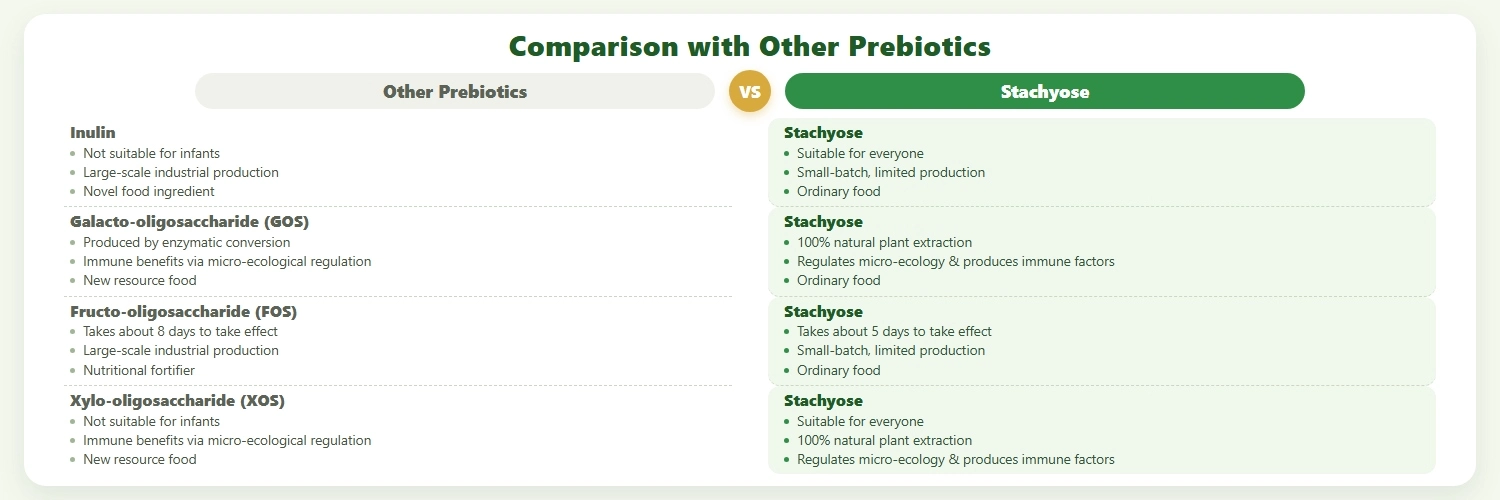
One of the most well-known prebiotic products in the US is inulin. Another is FOS. Both have been used in food for a long time. This sugar is made up of four different types. Raffinose is the name of the type of sugar. Flavonoids link together to make it. In Stachyose 80% Powder, the chains are long, but in FOS, they are short. Plus, it tastes better. It's made up of longer chains that don't dissolve easily and often give things more body. There are four sugar molecules in Stachyose. These molecules change how something breaks down and feels in your mouth. You can't just use one thing in every recipe. You need to make sure that each one meets the market rules, the serving size, and the taste goal.
Stachyose Versus GOS
Enzymes change lactose into GOS. GOS is a type of prebiotic that can be found in milk, drinks, and diapers. Stachyose could help a business that wants to use more plant-based products or less lactose. They both can't be broken down by the body because bugs in the gut do that. Some of the sugars that are still in commercial GOS are lactose, glucose, and galactose, so check the assay basis. The two specification sheets are structured, properly put, and come from different sources, so you should lay them next to each other and compare them. Ask each seller how the food was tested, what kinds of carbs were used, and how much it costs per serving. The weight doesn't really tell you how much something costs.
Choosing the Right Prebiotic for Your Product
The best prebiotic will depend on the food, how much you eat, how it tastes, and the market rules. A powder that is easy to mix in and doesn't have a lot of sweetness might go well with a clear, sour drink. So, a bar might need something that doesn't need to soak up a lot of water and can be baked. Stachyose 80% Powder is a good choice because it tastes good and keeps acids stable. Some companies put two or three prebiotics together and test each one again to see how it tastes and how stable it is. No matter what you pick, make sure you compare the professional grade and not just a list of the materials. Everyone needs to take the same lab test now. Then, they should be ranked by style, safety, wait time, and how much it costs to land.
Quality Standards, Supplier Evaluation, and Bulk Buying
Quality Standards and Documents to Request
The test is the first thing that is done to make sure quality. To get an idea of how much Stachyose is there, HPLC is used. When someone sells you something, they should explain how it was made, what standards were used, and what happened with each lot. Not only should you check for purity, but also for moisture, heavy metals, microbiological limits, and the ability to be tracked. Mold and heavy metals are on our list of standards that we meet. ISO22000, HACCP, and HALAL have also given us their seals of approval. If your market needs them, you should also ask about allergens, GMOs, safety, and where the food came from. For projects in the US, make sure you know what the item can do and what you can say about it. Check your process again to see how well it works. The first test was on paper, but this one isn't.
How to Choose a Dependable Stachyose 80% Powder Supplier?
These three things help me choose which Stachyose 80% Powder supplier to work with.
- Manufacturing and quality control: Who makes the ingredient, what licenses do they need, and how do they test each batch before we sell it? When a customer complains or wants a change, you should ask the seller how they handle it. This way, you'll know what they'll do if the standard changes or a customer reports a quality issue in the field.
- Capacity and export experience: Compare annual capacity with your forecast. Every year, 1,000 tons of things are made, and they can be sent by air or sea. This will make sure that your plant gets the things it needs on time and without any issues with customs. You can find out about delivery papers, wait times, minimum order amounts, pallet setups, and Incoterms.
- Technical service: People who work for the service should be able to answer your questions about content in simple English. They should also be able to share HPLC data and help you plan tests like those for stability and taste. Our team can help you make changes to formulas, work on technical projects together, help with testing and the process, and more.
These checks will let you know if a supplier can keep up with your needs after the first order.
Bulk Procurement Checklist and Common Pitfalls
Get a small amount of Stachyose 80% Powder first before you buy a lot of it. Along with a lot number and a certificate of authenticity (COA), this sample should have full information about what it is and how to store it. Before you expand it, test it in your formula first. Then, make sure it's clear about the minimum order quantity, how it will be packed, how long you will have to wait, how to pay, and how long the price is good for. We can help with shipping goods by sea or air. It is important to make sure that the powder is covered and that the right boxes or drums are used, because the powder soaks up water. People often make mistakes, like choosing the cheapest choice without reading the small print, deciding based only on the 80% number, not testing the solubility in acidic or protein-rich environments, and keeping the powder in damp rooms. For the US market, don't say anything about health that your team hasn't looked into.
Conclusion
We make sure that Stachyose 80% Powder, a tetrasaccharide prebiotic, has at least 80% Stachyose. It comes from plants. Tests alone aren't enough to say whether it can be used in healthy foods and drinks. Bifidobacteria in the colon can break it down, but people can't. After being tried out in the real formula, it works in acidic drinks, dairy, powdered mixes, and supplements. Taste, tolerance, solubility, heat and pH stability, and taste must all be tested on a bench or pilot scale. All of these sugars are different from Stachyose in terms of how they are made, where they come from, and how they taste. In other words, the shape of the object determines the best pick. Sound sourcing connects HPLC-based specs, batch records, certifications, packaging, store management, and supply capacity. It's safer to prepare and launch after this.
FAQ
What Is Stachyose 80% Powder Used For?
You can find this prebiotic in bars, yogurt, acidic drinks, capsules, sachets, and powdered drink mixes. You should test first because the recipe and the people you want to sell to will determine the amount, claims, and success.
Is It Stable During Processing and Storage?
From what we know about the technology, it stays stable in acidic places and after being pasteurized the normal way. Do not store the powder in a room that is warmer than 25°C or more humid than 60% of the time. You can keep it for 24 months.
Which Documents Should I Request Before Buying?
Ask for the specification sheet, a batch COA with HPLC results, ISO22000, HACCP, and HALAL certificates, as well as directions on how to store the product and a sample. Know the MOQ, the wait time, and how to pack as well. Find out where the food came from and if it is safe.
Do You Supply Bulk and Custom Orders?
Yes. You can keep up a steady production level of 1,000 tons per year, and you can handle both air and sea freight. The needs can be changed, and our team can help you test with HPLC and change the formulas.
Request FuYNature Stachyose 80% Powder Samples or a Bulk Quotation
Want to get Stachyose 80% Powder from a company that can make 600 tons of powder a year and is certified in HACCP, ISO22000, HPLC, and HALAL? FuYNature can send you samples, information, and a batch COA for FuYNature for your project. Email info@extrabroc.com with the amount, type of use, yearly amount, and packing needs you have, or go to extrabroc.com to learn more. The price, the MOQ, and the wait time will be sent back to you by our team.
References
1. Nature Reviews Gastroenterology & Hepatology, 2017: ISAPP consensus statement on the definition and scope of prebiotics
2. Carbohydrate Polymers, 2007: Non-digestible oligosaccharides, a review
3. Microbial Ecology in Health and Disease, 1990: Effects of soybean oligosaccharides on human faecal flora
4. Nutrients, 2013: Fiber and prebiotics, mechanisms and health benefits
5. The Journal of Nutrition, 1995: Dietary modulation of the human colonic microbiota, introducing the concept of prebiotics
6. British Journal of Nutrition, 2002: Gastrointestinal effects of prebiotics