How to Use Stachyose 80% Powder in Dairy Product Formulations?
Before you use Stachyose 80% Powder in dairy products, check the certificate of analysis to make sure the value and amount of moisture are correct. Next, figure out the dose by writing down the label's instructions, the serving size, and the amount of stachyose. It is safe to dissolve or dry-blend the powder before the drinks are pasteurized or before or after the yogurt goes sour. Next, check the pH, taste, color, and how long it will last. You should do tests in the lab first, then in the plant. This guide shows buyers and developers how to do everything, from making sure they understand the specs to choosing a supplier. This way, when they move from the test batch to the production batch, there are fewer surprises.
This guide is helpful for people in the US who buy things, work as food engineers, serve food, or are on private-label teams. A growing number of dairy brands want to buy foods with clear labels, prebiotics, less sugar, and better gut health. Stachyose can fit some of those briefs once the recipe has been proven to work.

Understanding Stachyose 80% Powder Before Formulation
What the 80% Specification Means
With HPLC, 80% of the stachyose was found. It has to be white, have a Stachyose level of 80% or more, and last for 24 months. Heavy metals and microbiology are up to par. When someone buys powder, I always tell them not to use the weight to figure out the dose, since the rest of the powder could be water or other carbs. The test results, the moisture level, and the microbes should all be backed up by a certificate of analysis (COA) that is specific to the batch. A formulator can't guess how much of the active ingredient will be in each serving without that paper.
Physical and Chemical Properties
Stachyose is made up of four sugar units: two galactose units, one glucose unit, and one fructose unit. That kind of sugar turns food brown, but this one doesn't. Making something with soda gives it about 22% of its sweetness, but it doesn't add much flavor. From what I've read, the powder is white, soaks up water quickly, and stays stable in acidic conditions with a pH range of 2.5 to 4.0. What this means is that the powder can take in water from the air. It matters how you store and handle it. In your own dairy matrix, make sure that every trait is there.
Why Dairy Developers Look at Stachyose
It was defined by the International Scientific Association for Probiotics and Prebiotics (ISAPP) as a substance that host microorganisms use to help the body. People study stachyose, an oligosaccharide that helps bacteria grow, to find out more about it. A study published in 2020 in the Journal of Agricultural and Food Chemistry discovered that gut microbiota could be changed by stachyose-rich galacto-oligosaccharides. These changes helped mice that were having trouble going to the bathroom. It's important to be very careful with label claims because what happens in mice doesn't always happen in people. Still, it makes sense to be interested. People already like dairy, and an oligosaccharide with a mild taste goes well with milk that has been fermented.
Setting Objectives and Following a Step-by-Step Workflow
Define the Product Objective First
I write down what the item needs to do before I pick a dose. The recipe is based on the claims that need to be made, the serving size, the shelf life, the cost per serving, and the pH the food should have. Stachyose 80% Powder can be considered a functional ingredient when developing products such as lactofermented milk, probiotic drinks, puddings, and nutrition drinks, depending on the formulation requirements. A protein dessert made for athletes should be safe for people over 65 to drink. Things like certifications, market rules, plant equipment, and the way things are packed are also important in the business world. When you give your supplier a written brief, they don't have to look over the formula as much. It also helps them come up with a good sample size and specification.
A Practical Addition Workflow
For the first tests, I think this is the right order.
- Verify the ingredient: Review the assay, moisture, microbiological limits, contaminant data, allergen status, GMO information, and origin. Record the lot number so every trial batch links back to a COA and can be traced if a question arises during an audit or customer review.
- Choose the addition method: Compare dry blending with other dry ingredients against pre-dissolving in warm water. Keep temperature, agitation speed, and hydration time identical across trials. Add the powder at one validated step, and change only one variable at a time so results stay comparable.
- Test the finished product: Measure pH, viscosity, homogeneity, sedimentation, taste, and microbiology at day zero and at planned intervals. Compare each sample with an untreated control. Include packaged units, because container, headspace, and transport can change results that looked fine in an open beaker.
You can turn an idea into a written plan by following these steps. Plus, they make it simple for your quality team to check the work and approve it.
Dosage Planning
Why don't I give the usual amount? To find the right amount, you need to look at the test, the serving size, and the labeling laws in your area. Before you can find out how much powder there is, you need to know how much stachyose you want in each serving. Then, divide that number by 0.80. To get 1 gram of stachyose, you need about 1.25 grams of an 80% powder. The people who sell it say that 3 to 5 grams a day is usually enough to help with digestion. But this amount is neither a legal limit nor a valid claim. Because different people can handle different amounts, a lot of developers test smaller amounts first. In the US, you should talk to a qualified advisor to find out about the ingredient's regulatory status, such as whether it has been approved as GRAS.
Formulation and Processing Considerations by Application
Yogurt and Fermented Milk
I watch how long it ferments, how acidic it gets, how thick the gel is, how viscous it is, and how the whey separates (syneresis). Test the starter culture with and without the powder to be sure. Stachyose may be a source of carbon for some bacteria. Adding it with the milk base is not the same as adding it after fermentation, like in a fruit paste. The yogurt text by Tamime and Robinson is one of many good sources that explain how acidity and gel structure change during fermentation. A strain-level study is important for both the FAO and the WHO when it comes to probiotics in food. Make sure the live counts are right if your record company calls a culture.
Dairy Beverages, Desserts, and Nutrition Products
When drinks are done being made, they need to be checked to see if they mix with proteins, break down, or stay mixed. It doesn't taste very different because stachyose is a little sweet. Large amounts, on the other hand, can make things more bulky and sweet. The food must be tested for its viscosity, its ability to gel, its ability to hold water, and its ability to freeze and thaw. You should find out more about how nutrients work together, who they're for, and how much each person needs to eat. People who work in health and nutrition have to follow stricter rules when they make claims, so I believe they should be involved from the start.
Heat, Acid, and Processing Compatibility
Heat the Stachyose 80% Powder, mix it well, let it ferment, and store it cold. This is how your plant tests it. They say it stays stable at high temperatures up to 120°C in environments that are neutral or slightly acidic. After you use that number as a guide, check how it works on your own HTST or UHT line. When you mix fruits, minerals, proteins, or stabilizers into dairy bases, different things may happen. For each solubility test, you can change how long the water is mixed, how hot it is, and how hard it is. This is why it's important to make test batches. If it's clear in water, it might not show how well it works in a base with a lot of solids.
Comparing Prebiotics, Solving Problems, and Scaling Up
Stachyose Compared with FOS, GOS, and Inulin
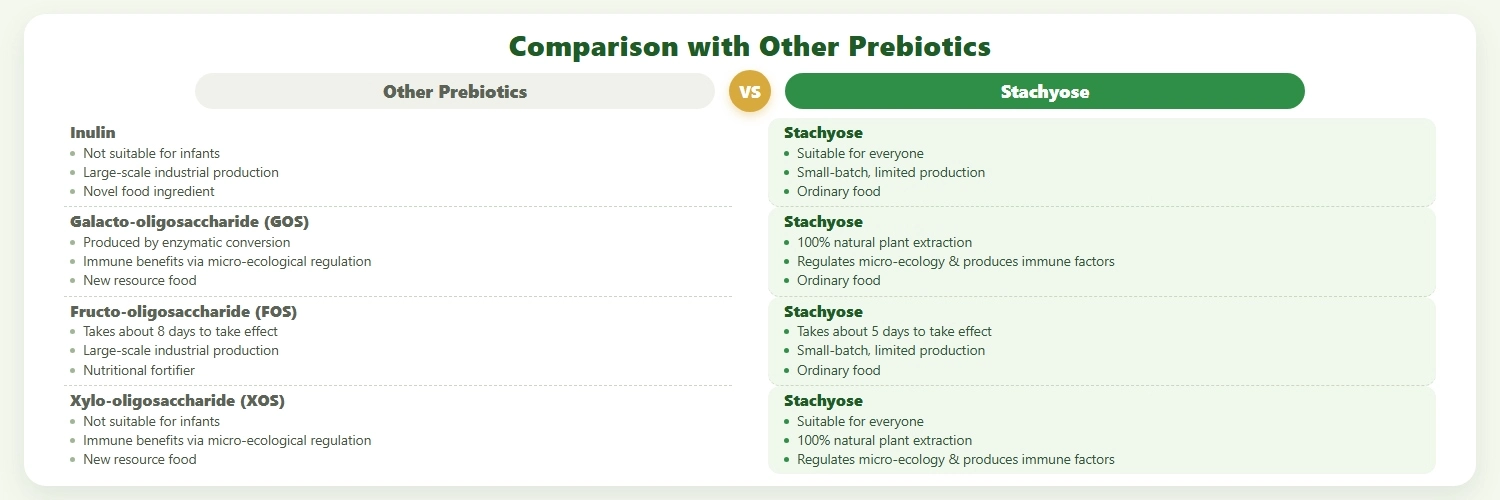
It's not just about price. There must also be times when the ingredients work well. Building blocks, solubility, sweetness, viscosity, mouthfeel, thermal stability, compatibility with fermentation, digestive tolerance, and cost-in-use are all things that you should think about. In 2007, Carbohydrate Polymers published a review of oligosaccharides that can't be broken down. This review looks at these technological aspects of the group as a whole. Fructooligosaccharides (FOS) and inulin are often found in foods that contain dairy. The sugar raffinose is similar to galactose and has it in it. While some sellers say that stachyose doesn't need as much FOS to work, I think that needs to be checked. There is a scoring matrix that checks that R&D and procurement are on the same page. The matrix looks at things like assay consistency, documents, supply, and technical help.
Common Problems and Practical Fixes
I always see clumping, slow dissolving, an aftertaste, sedimentation, phase separation, and uneven fermentation. When water gets into hygroscopic powder, it tends to clump together. Quickly close the bags and add the powder into a vortex instead of on top. When something takes a while to dissolve, adding warm water and letting it soak for longer usually makes it work better. If the stabilizers and proteins settle and separate, it's possible that they're not mixing right. Change how much stabilizer is used and how it is mixed to fix this. See if the growth of the yeast changed by looking at what was added before and after the culture. It is important to check the claims to make sure that the functions of the ingredients do not show up as unapproved claims. Test the product both at the factory and while it's being shipped.
Pilot Testing and Scale-Up
Strange things are less likely to happen in a staged show. In the lab, when you compare different levels of inclusion to a control, make sure that the temperature, mixing speed, time for hydration, and order of additions all stay the same. Try to make the mixing, heating, fermentation, filling, and batch size as similar to the commercial ones as possible for the pilot tests. Get the raw materials, put the powder in, clean, check the process controls, and guarantee that all the batches are the same before they are sold. As you do accelerated and real-time shelf-life studies, keep an eye on the pH, viscosity, flavor, color, microbiology, sedimentation, and the integrity of the package. You should keep records of everything you do. They will help with audits and internal approvals in the future.
Quality, Supplier Selection, and Storage
Quality and Documentation Requirements
The food-grade specification of an item should include its test results, how it looks and smells, how it mixes with other things, its microbiological limits, heavy metals, pesticides, allergens, GMO status, and how it can be tracked. There are fewer than 1,000 CFU/g on the plates, and the moisture level stays below 5%. This is how we use HPLC to check our Stachyose 80% Powder. The factories have ISO22000, HACCP, and Halal certifications, and tests for heavy metals and microbes have shown that they meet standards. Ask for a current COA, a technical data sheet, certification proof, trade documents, and information on where the goods came from. Next, add the step to your process for bringing in new items, assessing risks, releasing batches, and keeping samples.
Selecting a Stachyose Powder Supplier
Price per kg doesn't always tell you what's going on. These checks on the suppliers are the most important, in my opinion.
- Documentation and consistency: Compare samples against recent batch COAs for assay, moisture, solubility, and microbiology. Ask how the supplier controls changes, handles complaints, and traces each lot. Steady results across several batches matter more than one strong sample, and open data sharing shows confidence in the process.
- Capacity and logistics: Our stable production capacity is 1,000 tons per year, which supports large-scale orders. Ask any supplier about lead time, minimum order quantity, bulk packaging, and shipping terms. We support air and sea freight and can adjust product specifications based on client needs.
- Technical support: FuYNature comes from a team with 13 years in functional nutrition, a PhD-led R&D group, and 54 filed patents. Our services include formula customization, collaborative technical development, and HPLC process and testing support, which helps during pilot trials.
Work with a supplier that gives you more than just the cheapest quote at first. It rarely takes longer. This is very true if they offer space, technical help, and documents.
Packaging, Storage, and Shelf-Life Management
While it's being shipped, keep the powder away from water, heat, smells, and damage. They say it should be kept in containers that are double-sealed and can't hold water, below 25°C and below 60% relative humidity. Before you place your first order, you should ask your supplier about the performance, net weight, how the inner liner will be packed on pallets, and how it will be stored. Keep the bags somewhere cool and dry, out of direct sunlight. You can also use "first-in, first-out" to move the stock around. It can be kept for 24 months, and if you keep samples, your quality team can check them later if there are any problems. Once you open a bag, you need to close it again right away because moisture can make things stick together.
Conclusion
To use Stachyose 80% Powder in dairy, you need a clear test, a clear product goal, and a dose that is based on the stachyose content of the powder instead of its weight. Because different kinds of desserts, drinks, and yogurt act in different ways, it's important to test your recipes. If you want to know how well stachyose works, you should look at how much it costs and how well it is known to work. Tests in the lab, on a small scale, in plants, and at the end of the shelf life can find issues like clumping or sedimentation quickly. High-quality documents, certifications, production capacity, and dry storage help make sure that output is always the same. Label claims need to be checked by the government because tests on animals don't always show that something is good for people. Dairy teams should follow a set order, going from specification to scale-up, to get the most accurate results.
FAQ
Which dairy products can use Stachyose 80% Powder?
This word refers to a wide range of foods, including yogurt, fermented milk, dairy drinks, desserts, and health foods. Don't do any real tests yet, because the rules, dose, matrix, and process will affect how well it works.
How much powder should I add per serving?
You want to get to half as much stachyose as possible. It takes about 1.25 grams of powder to make one gram of stachyose. Talk to a person who works with rules about the claims and the limits.
How should I store the powder?
Do not put it in direct sunlight, and make sure it cannot get wet. It shouldn't get warmer than 25°C or less humid than 60%. It's good for 24 months.
Which documents should I request?
Ask where the food came from and for the allergen and GMO labels, as well as the COA, the technical data sheet, and the ISO22000, HACCP, and HALAL certificates.
Contact FuYNature for Stachyose 80% Powder Samples
Want to get Stachyose 80% Powder for projects that have to do with yogurt, drinks, or nutrition? Every year, FuYNature can make 600 tons of white powder and is free of stachyose (≥80% by HPLC). The ISO22000, HACCP, and HALAL labels are on it. Write to info@extrabroc.com about the product you want, how much you wish to buy each year, and where you would like the samples and technical documents to be sent. Please go to extrabroc.com to learn more.
References
1. Nature Reviews Gastroenterology & Hepatology, 2017. The International Scientific Association for Probiotics and Prebiotics (ISAPP) Consensus Statement on the Definition and Scope of Prebiotics.
2. Journal of Agricultural and Food Chemistry, 2020. Stachyose-Enriched α-Galacto-Oligosaccharides Regulate Gut Microbiota and Relieve Constipation in Mice.
3. Carbohydrate Polymers, 2007. Non-Digestible Oligosaccharides: A Review.
4. FAO/WHO, 2006. Probiotics in Food: Health and Nutritional Properties and Guidelines for Evaluation (FAO Food and Nutrition Paper 85).
5. Woodhead Publishing, 2007. Tamime and Robinson's Yoghurt: Science and Technology.
6. Federal Register, 2016. Substances Generally Recognized as Safe.