B2B Procurement of Stachyose 80% Powder for OEM Food Production
B2B procurement of Stachyose 80% Powder for OEM food production works best when buyers define the application, confirm the HPLC-verified assay, review safety and certification documents, test samples in the finished product, and compare total landed cost. Stachyose 80% Powder is a white, plant-extracted prebiotic oligosaccharide with a minimum stachyose content of 80%. It suits dairy products, acidic drinks, powder blends, and supplements. A clear specification, a qualified supplier, and pilot testing lower risk before a bulk order. In this guide, I explain each step for US-based food manufacturers, brands, and distributors so your team can source with confidence.
Understanding Stachyose 80% Powder as a Functional Ingredient
What Is Stachyose 80% Powder?
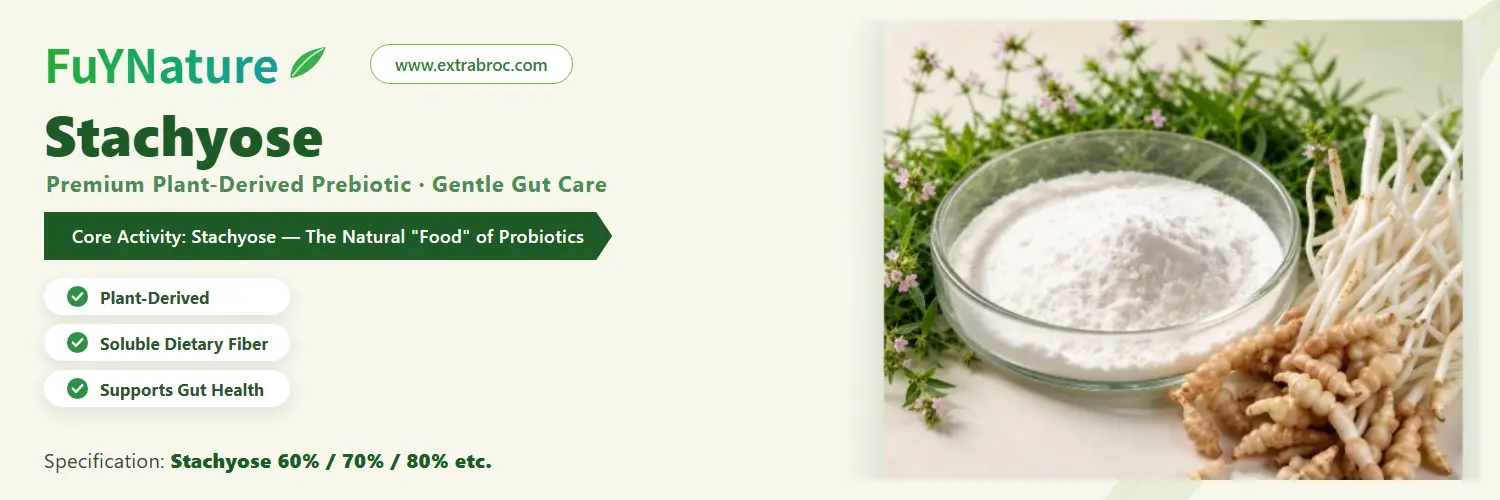
Stachyose is made up of four sugar units: two galactose units, one glucose unit, and one fructose unit. Its formula is C24H42O21, and its molecular weight is about 666.6. This oligosaccharide is found in beans and the stems of Stachys sieboldii, which is also known as Chinese artichoke. It is in the same family as raffinose. Labels that say "80% Powder" mean that at least 80% of the product is stachyose. It's the law. In this case, HPLC is the method. If different sellers use different words for the same things, you should still be able to tell the stachyose test from the others. When the beginning is clear, it's not possible for people to compare prices of different items.
Prebiotic Properties and Practical Benefits
A prebiotic is something that host microorganisms choose to use to make you healthier, according to the 2017 ISAPP consensus statement. Stachyose is an oligosaccharide that can't be broken down. Because people don't have enzymes that break it down, it can get into the gut and feed Bifidobacteria and Lactobacilli. It tastes mild, doesn't leave a taste in your mouth, and is about 22% as sweet as sugar, according to the numbers. When the method needs to be leveled out, this helps. Still, claims about things must be backed up by proof and follow the rules in the area. You should try the serving size, how it feels, how well it dissolves, and how well your body can handle it to find the right amount for you.
How Stachyose Compares With Inulin, FOS, and Raffinose?
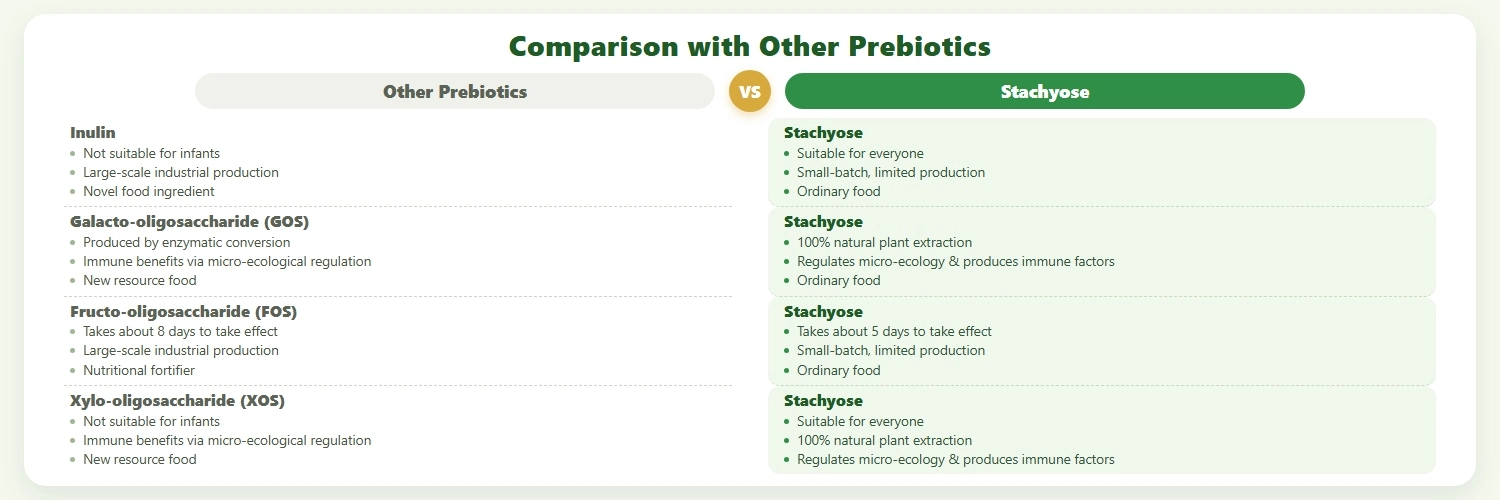
You should compare prebiotics based on how well they work instead of how much they cost, since each one is better at fixing a different flaw in the manufacturing process. It works well in bars and fiber blends because it gives them bulk and body. Raffinose is a smaller trisaccharide that is related to stachyose. It tastes less sweet than FOS, though. Because they are alive, probiotics are not like other foods. They need to be checked for strain identity, usable count, and packaging. Stachyose might be able to work with bacteria. To make an accurate comparison, you should write down the landed cost, the method of analysis, the fiber content, the solubility, the sensory effect, and the shelf life requirements. Then, checking out the end result will prove that the choice you made is the best one for your format.
Specifications and Quality Checks to Confirm Before Buying
FuYNature Stachyose Product Specification
Our spec sheet states the following: HPLC tests show that this product is a white powder with stachyose content ≥80%. The product is free of pathogenic bacteria and heavy metals, with a shelf life of 24 months. It holds ISO22000, HACCP and HALAL certifications. The raw materials are extracted from plants sourced in China. We have a stable annual capacity of 1,000 tons to support substantial OEM orders. FuYNature specializes in functional plant-based foods. Please verify whether each numerical indicator is a lower limit, typical value or fixed value, and be sure to obtain the batch-specific analysis certificate.
Physical and Chemical Properties That Affect Processing
Physical traits of Stachyose 80% Powder change how well you can process information. As we all know, stachyose powder is white and quickly dissolves in water that is warmer than 600 g/L. Because it soaks up water, mixing rooms need to be kept at the right temperature. It stays stable at temperatures up to 120 °C and pH levels between 2.5 and 4.0. This means it can be used in drinks that are slightly acidic or neutral, as well as in pasteurized dairy. So, I think you should first make your own mix and see how well it tastes, moves, and dissolves. As long as the powder is kept below 25 °C and 60% relative humidity in double-sealed, waterproof packaging, it will not clump.
Quality Control and Safety Testing
Being pure is the first thing that you need to do to keep quality in check. It takes HPLC and a refractive index detector to make sure the 80% level is met. Please make sure that this ingredient doesn't have any Salmonella or E. coli and that its moisture level is less than 5.0%. ICP-MS can find heavy metals. As per the FDA's Foreign Supplier Verification Programs rule, most people who bring food into the US must first make sure that it meets US safety standards. That's why it's important to have a full written file. Find out what limits each batch meets, and then match them line by line with the requirements you set when you received the batch.
How to Choose a Qualified Stachyose 80% Powder Supplier?
Verify the Supplier Type and Credentials
Before you do business with a company, find out if it is a producer, a trade company backed by a plant, a distributor, or a third party. You can see different amounts of output and change control with each type. Need certificates that are up-to-date and match the factory? See if the food has ISO 22000, HACCP, GMP, or Halal certifications. You can follow the rules in ISO 22000:2018 to make sure that food safety is taken care of at all points in the food chain. Taking steps to lower the risk is the case here. To get a cover letter for a new batch, safety data sheets, help with samples, lead times, and export documents, you should ask. Make sure it's clear what you mean when you answer.
Why Source From a Manufacturer-Backed Supplier?
FuYNature serves the global market with extensive industry experience. You can connect with our R&D team and production partners certified to GMP, ISO22000, HACCP and HALAL. Backed by this system, purchasers can access batch traceability, formula adjustment and supply planning in one stop. We offer custom products tailored to customer requirements, together with supporting shipping and logistics services. Direct contact with our responsible person can greatly cut down your waiting time for communication.
Building a Supplier Scorecard
A scorecard turns your thoughts into numbers that you can use to compare them. Truth and following the rules are what I think are most important. Things like testing, composition, food safety, certificates, microbiological control, and keeping track of them all fall into this group. After that, rate the item on how well it works, tastes, mixes, and stays the same from one batch to the next. If you want to rate how reliable a supply is, you should look at backups, capacity, wait time, and packaging. Things like price, MOQ, payment terms, and arrival cost are business-related. Lastly, rate how much expert support, OEM flexibility, legal help, and contact you get. You can write it down so that your R&D, purchasing, and quality teams can all use the same proof for each score to give a vendor the green light.
Planning the Bulk Procurement Process
Step-by-Step Process From Brief to Contract
When you stick to a chosen method for Stachyose 80% Powder, the quality, cost, and chance of not getting it right go down. Outline what you plan to use it for, how pure you desire, who you wish to sell it to, how you plan to package it, how much you wish to sell each year, and what certificates you require. Use the sources you've chosen to get examples and technical files. Next, test your work with pilots and in the lab. The landed cost of an item includes everything that goes into making it, packing it, testing it, sending it, protecting it, paying for shipping, customs, taxes, and payment fees, and finally receiving the item. The price should be set this way. The final specification, MOQ, Incoterms, payment terms, batch-release rules, nonconformance processes, and change-control tasks should be written into the supply agreement after the pilot test shows that the product works as planned. It's possible to start making plans early because the machine can handle 1,000 tons per year.
Common Procurement Risks and How to Avoid Them
A few important things are the cause of a lot of problems. Different suppliers have different ideas about what "80%" means, so one quote could hide active content that isn't as useful. People buy apps but don't test them, and some people learn too late that they need exit papers. If there isn't enough of something, it may also take longer to come out. Before you place an order, it's best to agree on the method of analysis and the details. You should also use test samples the same way you would use the real product and not just look at the unit price. The batch number and the location where the goods were made should match. Contracts should have language about tracking, backup space, replacement methods, and what to do with material that doesn't meet standards. As the market and number of suppliers grow, you can keep things under control with an approved-supplier file.
Practical Buying Checklist
After going over three groups of checks, I give the order for Stachyose 80% Powder the go-ahead.
- Technical checks: It checks the technology by asking who will use it and how, as well as making sure the 80% stachyose assay and HPLC method work. The specification and a recent CoA should also be requested. Make sure the samples can break down, taste, stay wet, and work with other things that are being processed. Check for allergens, GMOs, and dates for when the food was made, stored, and thrown away.
- Regulatory and document checks: You should look at the ISO22000, HACCP, and Halal certificates for the production site to make sure it follows all the rules and has all the right paperwork. Talk to a good regulatory lawyer if you want to know how your market handles nutrients like fiber claims and tag statements. They should also read 21 CFR Part 111, which has the cGMP rules.
- Commercial and logistics checks: You should write down the accepted specification, quantity, packaging, batch needs, shipping terms, Incoterms, and payment terms on the purchase order. This is for business and logistics checks. How long does the wait time last? Can you ship by air or sea? What are the steps for nonconformance and change control? Find out how much all of the deals cost.
You can use these checks to find out about business, the law, and technology before the money goes out.
OEM and Private-Label Applications for Stachyose 80% Powder
Functional Dairy and Acidic Beverages
Between pH 2.5 and 4.0, stachyose doesn't change much, so it's easy to mix with acidic things. Since the powder is slightly sweet and doesn't leave a bad taste, it can be mixed in with yogurt, yogurt that can be drunk, and sour juice drinks without changing the taste too much. The process of normal pasteurization works as long as the air is normal or slightly acidic and the temperature stays above 120 °C. But each plant should check this on its own line. Stachyose doesn't cover up other tastes because it doesn't taste strong. This is helpful for clean-label teams that need an ingredient that works well and doesn't make other ingredients taste bad.
Powder Blends, Nutrition Foods, and Supplements
If the recipe can handle the fact that stachyose soaks up water, it can be used in fiber blends, sachets, meal replacements, drink mixes, and other things. Keep the humidity low while you blend and use containers that don't let water in. This will help keep the food from caking. Stachyose can work with probiotic strains that come in capsules and powder form. These are called synbiotics, and a lot of brands want to use them. You should try the product's taste, how stable it is, and how well it works with your stomach to find the right amount and dose size. There are many sources that say eating 3 to 5 grams a day is good for your gut health. The people in charge of setting rules should check to see if these claims and amounts are legal in the US market.
OEM Support and Customization
We can change some things about a product to fit the needs of a customer if they ask us to. We make formulas that work for you as part of what we do. As part of this, the amount of ingredients, dose forms, and mix formulations will be changed. We can also help you get patents, test your process and products using HPLC analysis, and work with you to make new technologies. It will depend on how much you buy. You can send things abroad by both air and sea freight. Let us know what kind of product you want to make, how many servings you want, and who you want to sell it to. We'll help you with samples and test runs.
Conclusion
To get Stachyose 80% Powder for OEM food production, you need a clear standard, tests that can be checked, and a service with records that can be kept track of. As a tetrasaccharide prebiotic, stachyose should not be taken at face value; it should be linked to an HPLC test. As it is slightly sweet, it dissolves in water and stays stable in hot and acidic foods and drinks. This makes it good for cheese, drinks, powder mixes, and vitamins. We need to test each recipe first with a small batch. You shouldn't just look at price to choose between inulin, FOS, and raffinose. It is safer to buy when the terms of the contract, licenses, scorecard results, and information about the type of supplier are all clear. Before something goes on sale in the US, people who want to buy it should also look at what the label says, how it fits with regulations, and have its sources checked.
FAQ
What does "80%" mean on a specification?
At least 80% of the powder is stachyose, as shown by HPLC. What method did the seller use? Some give you total oligosaccharides instead, so it's important to know.
How should I store it?
It needs to be kept below 25 °C and 60% relative humidity in containers that are double-sealed and can't let water in. It's good for 24 months.
Is it suitable for acidic or heated products?
When the pH is normal or slightly acidic, the chemical stays stable between 2.5 and 4.0 and up to 120 °C. Look at this in your own work.
Which documents should I request?
You should ask for the standard sheet, the export papers, the CoA for each batch, the safety data sheet, and the ISO22000, HACCP, and HALAL certificates.
Can I make health claims?
Claims must follow the law and be backed up by proof in the area. Before you put labels on things, you should talk to a lawyer.
Request FuYNature Stachyose 80% Powder Samples and a Bulk Quote
FuYNature supplies 80% Stachyose Powder and supports your OEM projects. Feel free to contact us for inquiries. We hold ISO22000, HACCP and HALAL certifications. HPLC analysis confirms this white powder contains ≥80% stachyose with a 24-month shelf life. Our annual capacity reaches 600 tons to accommodate large-volume orders. We can adjust specifications to meet your requirements and arrange sea or air shipment. Check out extrabroc.com or send an email to info@extrabroc.com to get a price, example, or sheet of specs for many things.
References
1. Nature Reviews Gastroenterology & Hepatology, 2017. The International Scientific Association for Probiotics and Prebiotics consensus statement on the definition and scope of prebiotics.
2. Critical Reviews in Food Science and Nutrition, 2008. Alpha-galactosides: antinutritional factors or functional ingredients?
3. Current Opinion in Biotechnology, 2016. Prebiotics: why definitions matter.
4. U.S. Food and Drug Administration, 2015. Foreign Supplier Verification Programs for Importers of Food for Humans and Animals.
5. U.S. Food and Drug Administration, 2007. Current Good Manufacturing Practice in Manufacturing, Packaging, Labeling, or Holding Operations for Dietary Supplements (21 CFR Part 111).
6. International Organization for Standardization, 2018. ISO 22000:2018, Food Safety Management Systems.

-Equol 99_1786504214662.webp)